

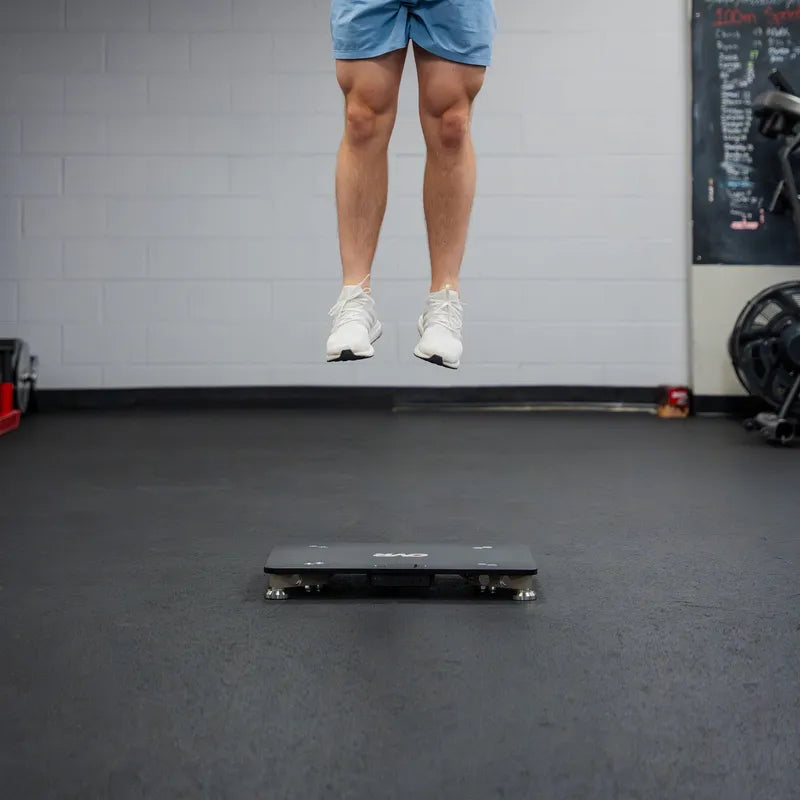


Strength and power are often treated as the same quality, but the distinction matters in practice. Strength is the ability to produce force. Power is the force an athlete produces while the load is moving, force multiplied by velocity. For weaker or less-trained athletes, strength generally translates to power. As athletes develop, that relationship starts to decouple, and training one doesn't always mean progress in the other. A barbell velocity tracker makes this visible in real time, showing which quality the training is building.
Strength and Power Are Not the Same Thing
The formula is straightforward: Power = Force x Velocity. Improving either part improves power output. Research shows that ground contact times in fast actions like sprinting and reactive jumping typically fall between 100 and 300 milliseconds [2]. Strength built in the weight room translates best when athletes can express force within those short contact times.
High force production at slow velocities reflects strength, while high velocity with limited force reflects speed. Power sits where both are sufficient to multiply into meaningful output, and that combination requires deliberate training [1].
Getting Stronger Helps, Until It Doesn't
For weaker or less-trained athletes, strength generally translates to power as force production is usually the limiting factor. When the neuromuscular system hasn't been trained to produce high levels of force, building that capacity through resistance training improves power output as a natural consequence. The two qualities develop in parallel at this stage because they share the same constraint.
That relationship starts to change as athletes develop. A meaningful strength base takes time to build, and most athletes have more room to grow on the strength end than they realize. But at some point, continued strength work alone becomes insufficient as the primary driver of power development. The limiting factor shifts from how much force an athlete can produce to how quickly they can produce it. Adding weight to the bar addresses the first problem, not the second [1].
At the high end of the strength curve, being strong at slow speeds doesn't mean being strong at fast ones [3]. An athlete with a solid strength base can add 20 pounds to their squat and see no change in jump height or sprint time when the training hasn't addressed the speed side [3]. Vertical jump data can surface this imbalance, showing where an athlete's explosive output sits relative to their strength level [3].
Where Power Lives on the Force-Velocity Curve
At max load, velocity is low and power output drops off. At no load, velocity is high but force is minimal. Power peaks somewhere in the middle [2].
| Velocity Zone | Approx. %1RM | Bar Speed | Power Output |
|---|---|---|---|
| Absolute Strength | 80–100% | <0.50 m/s | Low |
| Accelerative Strength | 60–85% | 0.50–0.75 m/s | Moderate |
| Strength-Speed | 40–70% | 0.75–1.00 m/s | High |
| Speed-Strength | 20–50% | 1.00–1.30 m/s | High |
| Starting Strength | <20% | >1.30 m/s | Low |
Peak power in lower-body compound movements tends to occur in the moderate load range, roughly where the strength-speed and speed-strength zones sit in the table above [1]. Heavy work builds the force capacity that underpins power, while lighter, faster work trains how quickly that force can be expressed. Both matter, and how the emphasis shifts across an off-season shapes how a program should be structured.
How to Train Both, In the Right Order
In the off-season, emphasis goes toward absolute and accelerative strength, with heavier loads, lower velocities, and the primary goal of building the force ceiling. As competition approaches, the emphasis shifts toward expressing that strength at higher velocities through lighter loads and more ballistic work. Strength doesn't disappear from the program at that stage; it gets maintained at lower volumes while power takes priority [4].
This is not a rigid rule. Athletes in-season still need to maintain strength, and some come in strong but slow, meaning the prescription shifts earlier toward speed-end work. Managing strength and power in-season is where programming decisions tend to have the most visible impact.
Measuring Whether Your Training Is Actually Working
Tracking strength is straightforward: load, reps, progress over time. Most programs do this well, and tracking power builds directly on top of it. For coaches without access to force plates or lab testing, bar speed is one of the most practical ways to track power output in the weight room, showing rep by rep how output changes within a set and across sessions [5].
Vertical jump is one of the most practical field measures of lower-body power in a coaching setting [6]. When strength is trending up and jump height is following, the training is transferring across both qualities. When the two diverge, that's useful information about where to focus next. Understanding how to measure vertical jump consistently is what makes those comparisons meaningful over time. Together, both data points give athletes and coaches a clearer read on which quality is developing and where the program needs to go.
Putting It Together
Athletes sit at different points on the strength-power spectrum, and understanding which quality is currently the limiting factor is what makes the training prescription specific rather than general.
Across most contexts, a few principles tend to hold. Heavy work in the lower velocity zones builds force capacity, while faster, more ballistic work in the higher zones develops the ability to express it. The emphasis between the two rotates by phase, but neither quality leaves the program entirely. Bar speed is one of the most accessible ways to track power output in the weight room, and jump height is one of the most practical field measures of whether that power is transferring to explosive output. When both are trending in the right direction across a training block, that's a strong signal the program is addressing both qualities.
| Quality | How to Develop It | What to Watch |
|---|---|---|
| Strength | Work in absolute and accelerative strength zones with high effort | Bar speed holding or improving at a given load over time |
| Power | Work in strength-speed and speed-strength zones with maximal intent | Bar speed at submaximal loads; jump height across a training block |
| Transfer | Training across the full spectrum with emphasis rotating by phase | Both metrics trending in the same direction; divergence points toward where to focus |
The athletes who tend to perform most consistently are those whose training addresses both ends of the force-velocity curve and uses data to confirm each quality is actually developing.
References
-
Haff, G. G., & Nimphius, S. (2012). Training principles for power. Strength and Conditioning Journal, 34(6), 2–12.
-
Turner, A. N., & Jeffreys, I. (2010). The stretch-shortening cycle: proposed mechanisms and methods for enhancement. Strength and Conditioning Journal, 32(4), 87–99.
-
Morin, J. B., & Samozino, P. (2016). Interpreting power-force-velocity profiles for individualized and specific training. International Journal of Sports Physiology and Performance, 11(2), 267–272.
-
Haff, G. G., & Triplett, N. T. (Eds.). (2016). Essentials of strength training and conditioning (4th ed.). Human Kinetics.
-
Weakley, J., Mann, B., Banyard, H., McLaren, S., Scott, T., & Garcia-Ramos, A. (2021). Velocity-based training: From theory to application. Strength and Conditioning Journal, 43(2), 31–49.
-
Cormie, P., McGuigan, M. R., & Newton, R. U. (2011). Developing maximal neuromuscular power: Part 1 — Biological basis of maximal power production. Sports Medicine, 41(1), 17–38.


