
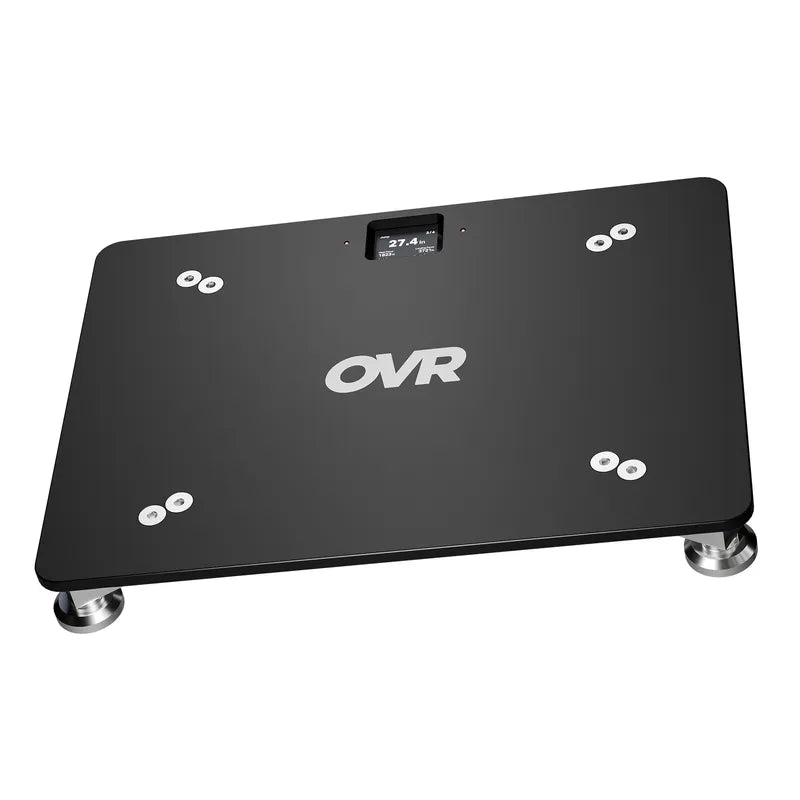
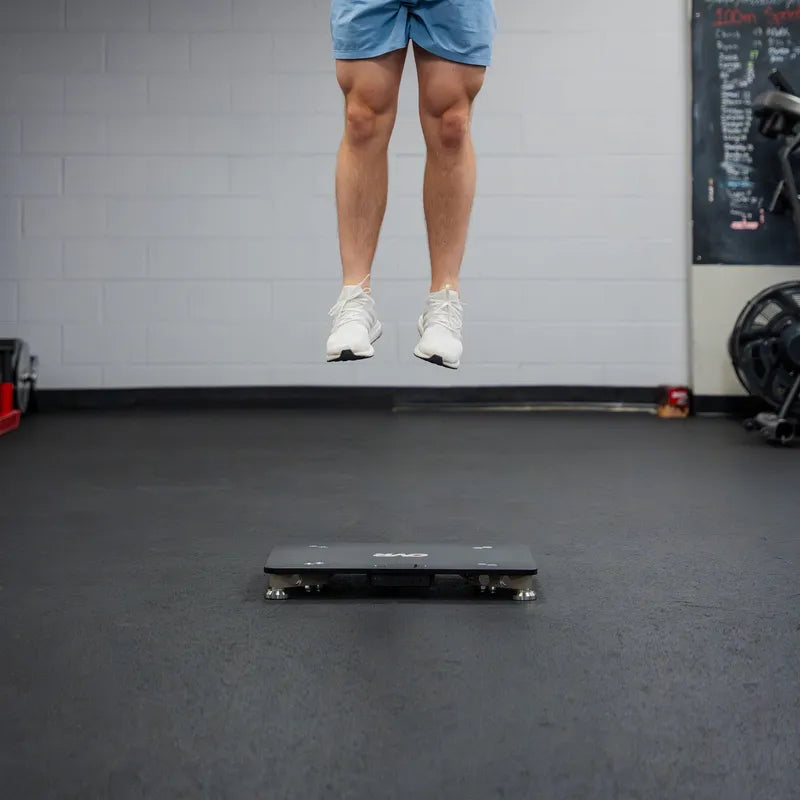


The drop jump is one of the quickest ways to measure reactive strength: how fast an athlete absorbs a landing and springs back off the ground. Step off a box, rebound as hard as you can, and the reactive strength index (RSI) scores it. A clean rep is what makes the number one you can trust and track. On a force plate, each rep also gives you the exact ground contact time and the landing force, so you can confirm a good rep on the spot. Run it well, read the data live, and you get a reactive-strength number you can act on.
Set the box height before anyone steps off
Drop height is a choice, and higher is not better. RSI climbs with box height to a point, then falls: past an athlete's optimum, contact time grows faster than the jump. Most athletes peak in the 12 to 18 inch range (about 30 to 46 cm).
For monitoring, pick one height and keep it consistent; 12 or 18 inches both work, because a height change between sessions makes the trend meaningless. To find an athlete's optimum, run a ladder (12, 18, 24 inches), three to five reps each, and stop when contact time crosses 250 ms or RSI falls two heights in a row (one dip can be noise). That peak is their training drop height. Cap it on competency too: if they can't land and rebound cleanly at a height, it is too high.
Coach the rep: step off, fast not high
The athlete steps off the box leading with one foot, not a two-footed drop or a jump off the edge. Jumping off adds height you did not choose and corrupts the contact time. They land where they stepped, hands on hips throughout, since an arm swing adds about 10 percent to the jump.
Cue speed, not height: "as fast as possible," not "as high as possible." A quick contact is what makes the rep reactive. Off a 30 cm box, the same athlete can post an RSI near 1.24 with a fast bounce and 0.91 with a slow countermovement style, with contact time 0.23 s versus 0.39 s. Same jump, different number, so hold the cue constant across sessions.
Spot a junk rep before it pollutes the data
Contact time is your live validity check. A true reactive drop jump stays under 250 ms, and most good reps land between 150 and 250 ms. Anything longer is a countermovement off the box, not a drop jump, and does not belong in the same data set.
Discard true faults only: hands off hips, a heel slam, a contact over 250 ms. Do not toss a rep just because it reads low. A valid low rep is information, and pruning to lift the average manufactures a score and ruins your monitoring.
What counts as a good RSI
RSI on the Force is jump height divided (m) by ground contact time (s). Some online charts use a different formula (flight time divided by contact time) and read higher. What counts as good depends on age and training level: RSI bands by level rise steadily from middle school to pro, so read a score against where the athlete sits.
Trials, and what to watch over time
Run about three to five reps per athlete, 60 seconds apart. The best rep is the athlete's rolling PR; the average of the valid reps is the steadier number to watch for fatigue, since the RSI ratio is noisier than the contact time and jump height that feed it. Both read off the same set of reps.
The trend matters more than any single number. Track each athlete against their own baseline over time, and against the bands for their level. When contact time creeps up across sessions at the same box height, that is reactive fatigue, a deload signal. Read alongside contact time, RSI also points at the limiter: low RSI with a short contact means force-limited, so add strength; low RSI with a long contact means reactive-limited, so add depth jump training, pogos, and ankle stiffness work.
For a squad, one fixed height keeps the line moving. The on-device display and Coach View let you read each result and rotate the next athlete in without a laptop, and the rotation itself covers the rest between reps.
From a number to a decision
Run on a force plate, the drop jump becomes a real, accessible number you can work with. The contact time and landing force behind each rep are what let you spot a junk rep, set the right height, and catch fatigue early. Keep the rep clean and the number consistent, and it feeds into the plyometric training that builds reactive strength, the quality you just measured. No matter what, stay consistent with your protocol, because numbers become useful only when they are produced the same way every time.
Sources
- ScienceForSport, Reactive Strength Index: https://www.scienceforsport.com/reactive-strength-index/
- ScienceForSport, Incremental DJ-RSI Test: https://www.scienceforsport.com/incremental-dj-rsi-test/
- Louder, Thompson, Banks, Bressel 2019, Sports (Basel), Internal validity of RSI: https://pmc.ncbi.nlm.nih.gov/articles/PMC6680983/
- Struzik, Juras, Pietraszewski, Rokita 2016, Journal of Human Kinetics, Effect of drop jump technique on RSI: https://pmc.ncbi.nlm.nih.gov/articles/PMC5260527/
- Healy, Kenny, Harrison 2016, Journal of Human Kinetics, Reactive strength measures: https://pmc.ncbi.nlm.nih.gov/articles/PMC5187958/
- Montoro-Bombú, Field, Santos, Rama 2022, Frontiers in Bioengineering and Biotechnology, Drop jump validity and reliability: https://www.frontiersin.org/journals/bioengineering-and-biotechnology/articles/10.3389/fbioe.2022.1015526/full
- Flanagan & Comyns 2008, Strength and Conditioning Journal, Contact time and the reactive strength index: https://journals.lww.com/nsca-scj/fulltext/2008/10000/the_use_of_contact_time_and_the_reactive_strength.5.aspx
- stack.com, The best coaching cue for drop jumps: https://www.stack.com/a/study-reveals-the-best-coaching-cue-to-use-for-drop-jumps/
- SimpliFaster, Reactive strength output (Pedley): https://simplifaster.com/articles/reactive-strength-output-measure-plyometrics/
- SimpliFaster, Buyer's guide to contact mats: https://simplifaster.com/articles/buyers-guide-contact-mats/
- Hawkin Dynamics, Drop jumps: what to measure (Pedley): https://www.hawkindynamics.com/blog/drop-jumps-what-to-measure
- Topend Sports, Drop jump test: https://www.topendsports.com/testing/tests/drop-jump.htm
- Topend Sports, Incremental drop jump test: https://www.topendsports.com/testing/tests/drop-jump-incremental.htm
- Applied Performance, Best drop height for training RSI: https://www.appliedperformance.co/blog/whats-the-best-drop-height-for-training-rsi/
- PMC, Validity and reliability of an electronic contact mat for drop jump: https://www.ncbi.nlm.nih.gov/pmc/articles/PMC6572231/
- Output, Guide to reactive strength index: https://www.outputsports.com/blog/guide-to-reactive-strength-index


