

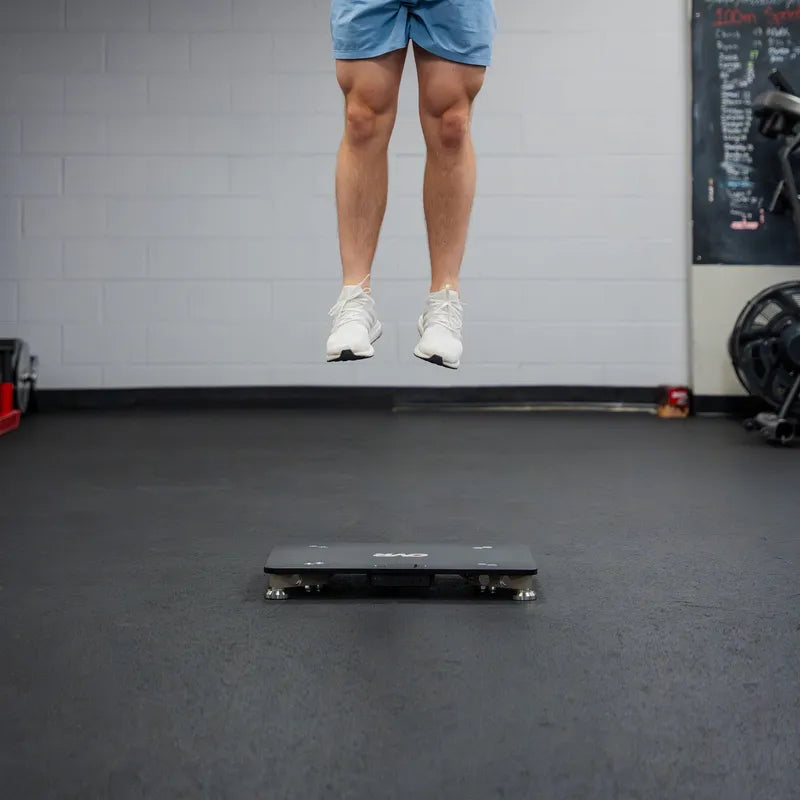


"Explosive" is one word for four different ways an athlete produces force, separated by how much time is available. They are maximal strength, how fast force rises early in a contraction, power, and reactive strength. An athlete can rank high on one and ordinary on another, so work that raises one will not necessarily move the others. A portable force plate covers all four across three tests, and the lowest of the four is the one to train.
Most programs already track jump height, and on its own it does not separate the four. In 394 collegiate athletes, countermovement jump force curves sorted into three patterns, and two groups reached the same height different ways [1]. Those four describe how each athlete produced that height.
What each one is and how it is measured
Maximal strength is the most force an athlete can produce when time is not limited. The isometric mid-thigh pull measures it, a maximal pull against a fixed bar.
How fast force rises early is the force an athlete produces in the first fraction of a second, before maximum is reached. It comes off the same pull, measured at 100 milliseconds, which is about how long a foot is on the ground in a sprint.
Power is the force an athlete produces while the load is moving, force multiplied by velocity. Peak power measures it in watts, and a countermovement jump reports it per kilogram of bodyweight so athletes of different sizes compare fairly.
Reactive strength is force produced during a fast stretch-shortening cycle, the quick stretch and rebound when an athlete lands and comes straight back up. Fast means the foot is down for less than about 250 milliseconds [2]. A drop jump on a laser tester or a plate gives the reactive strength index, jump height divided by ground contact time.
The limiter changes as the athlete develops
For a weaker athlete the limiter is usually still strength. In the first hundredth of a second of a contraction, how strong an athlete is explains only 18 percent of the difference between athletes in how fast force rises. At a tenth of a second it explains 57 percent. At a fifth of a second, 78 percent [3]. Athletes who added squat strength ran about 3 percent faster [4].
Once an athlete is strong, fast work produces bigger gains. Two groups ran the same 10-week program. The group squatting about twice bodyweight improved jump squat speed 5.7 percent. The group at 1.2 times bodyweight improved 1.6 percent [5].
Strength and reactive strength stay largely separate. An athlete can pull a big isometric number and still have low reactive strength [6]. The two do connect at higher drop heights, where weaker athletes lose reactive strength index as the box rises and stronger athletes hold it [7]. In a weaker athlete a low strength number comes with low numbers across the board. In a strong athlete the strength number says nothing about the other three, so two athletes with the same pull can need opposite work.
What moves each one
Maximal strength responds to heavy loading. Power output tends to stay low until an athlete is relatively strong, which is why a strength block comes first for developing athletes [8].
Power moves when force or velocity moves. Train it at the load where the two multiply out highest: at or below 30 percent of one-rep max in a jump squat, 30 to 70 percent in a back squat, 70 percent or above in a power clean [9]. Weightlifting training beat traditional resistance training for jump height [10]. At a fixed load, rising average bar speed means rising power.
Reactive strength responds to plyometric work with short ground contacts, meaning bounds, hops and rebound jumps. Run blocks longer than seven weeks, three sessions a week, more than 14 sessions total. Across 61 studies and 2,576 athletes those programs improved the reactive strength index more than shorter or less frequent ones [11]. Keep ground contact under about 250 milliseconds. Past that the drill is not training reactive strength [2].
Early force production responds to fast work where the athlete drives the load hard from the first instant. In the first 50 to 75 milliseconds, how fast force rises is set mostly by how quickly the nervous system can recruit the muscle [3]. Heavy lifting trains it too, as long as the intent is to accelerate, because both routes work by speeding up muscle activation. Four weeks of isometric strength training raised maximal force and left the early part of the force curve unchanged [12], so strength gains on their own do not reliably carry over.
Sprinting moves maximal strength, power and reactive strength. Ten weeks of maximal sprints from 10 to 50 meters raised isometric squat strength 10 percent, countermovement jump power 7 percent, and drop jump performance 15.6 percent, matching or beating a plyometric program run over the same weeks [13]. Sprinting is also the most specific stimulus for sprint performance itself, with strength, power and plyometric work filling in the components underneath it [14].
Measure the four against the athlete's own baseline and train whichever one is low. Athletes trained on their low number gained 12 to 14 percent in jump height over nine weeks. Athletes given the same work regardless of their numbers gained 2.3 percent [15]. Re-test the same way you tested the first time.
Sources
- Guess TM, Gray AD, Willis BW, Guess MM, Sherman SL, Chapman DW, Mann JB (2020). Force-Time Waveform Shape Reveals Countermovement Jump Strategies of Collegiate Athletes. Sports, 8(12), 159. https://doi.org/10.3390/sports8120159
- Flanagan EP, Comyns TM (2008). The Use of Contact Time and the Reactive Strength Index to Optimize Fast Stretch-Shortening Cycle Training. Strength and Conditioning Journal, 30(5), 32-38. https://doi.org/10.1519/SSC.0b013e318187e25b
- Maffiuletti NA, Aagaard P, Blazevich AJ, Folland J, Tillin N, Duchateau J (2016). Rate of force development: physiological and methodological considerations. European Journal of Applied Physiology, 116(6), 1091-1116. https://doi.org/10.1007/s00421-016-3346-6
- Seitz LB, Reyes A, Tran TT, Saez de Villarreal E, Haff GG (2014). Increases in Lower-Body Strength Transfer Positively to Sprint Performance: A Systematic Review with Meta-Analysis. Sports Medicine, 44(12), 1693-1702. https://doi.org/10.1007/s40279-014-0227-1
- James LP, Haff GG, Kelly VG, Connick MJ, Hoffman BW, Beckman EM (2018). The impact of strength level on adaptations to combined weightlifting, plyometric, and ballistic training. Scandinavian Journal of Medicine & Science in Sports, 28(5), 1494-1505. https://doi.org/10.1111/sms.13045
- Jarvis P, Turner A, Read P, Bishop C (2022). Reactive Strength Index and its Associations with Measures of Physical and Sports Performance: A Systematic Review with Meta-Analysis. Sports Medicine, 52(2), 301-330. https://doi.org/10.1007/s40279-021-01566-y
- Beattie K, Carson BP, Lyons M, Kenny IC (2017). The Relationship Between Maximal Strength and Reactive Strength. International Journal of Sports Physiology and Performance, 12(4), 548-553. https://doi.org/10.1123/ijspp.2016-0216
- Cormie P, McGuigan MR, Newton RU (2011). Developing maximal neuromuscular power: part 2, training considerations for improving maximal power production. Sports Medicine, 41(2), 125-146. https://doi.org/10.2165/11538500-000000000-00000
- Soriano MA, Jimenez-Reyes P, Rhea MR, Marin PJ (2015). The Optimal Load for Maximal Power Production During Lower-Body Resistance Exercises: A Meta-Analysis. Sports Medicine, 45(8), 1191-1205. https://doi.org/10.1007/s40279-015-0341-8
- Morris SJ, Oliver JL, Pedley JS, Haff GG, Lloyd RS (2022). Comparison of Weightlifting, Traditional Resistance Training and Plyometrics on Strength, Power and Speed: A Systematic Review with Meta-Analysis. Sports Medicine, 52(7), 1533-1554. https://doi.org/10.1007/s40279-021-01627-2
- Ramirez-Campillo R, Thapa RK, Afonso J, Perez-Castilla A, Bishop C, Byrne PJ, Granacher U (2023). Effects of Plyometric Jump Training on the Reactive Strength Index in Healthy Individuals Across the Lifespan: A Systematic Review with Meta-analysis. Sports Medicine, 53(5), 1029-1053. https://doi.org/10.1007/s40279-023-01825-0
- Del Vecchio A, Casolo A, Dideriksen JL, Aagaard P, Felici F, Falla D, Farina D (2022). Lack of increased rate of force development after strength training is explained by specific neural, not muscular, motor unit adaptations. Journal of Applied Physiology, 132(1), 84-94. https://doi.org/10.1152/japplphysiol.00218.2021
- Markovic G, Jukic I, Milanovic D, Metikos D (2007). Effects of Sprint and Plyometric Training on Muscle Function and Athletic Performance. Journal of Strength and Conditioning Research, 21(2), 543-549. https://doi.org/10.1519/R-19535.1
- Haugen T, Seiler S, Sandbakk O, Tonnessen E (2019). The Training and Development of Elite Sprint Performance: an Integration of Scientific and Best Practice Literature. Sports Medicine - Open, 5(1), 44. https://doi.org/10.1186/s40798-019-0221-0
- Jimenez-Reyes P, Samozino P, Brughelli M, Morin JB (2017). Effectiveness of an Individualized Training Based on Force-Velocity Profiling During Jumping. Frontiers in Physiology, 7, 677. https://doi.org/10.3389/fphys.2016.00677


