
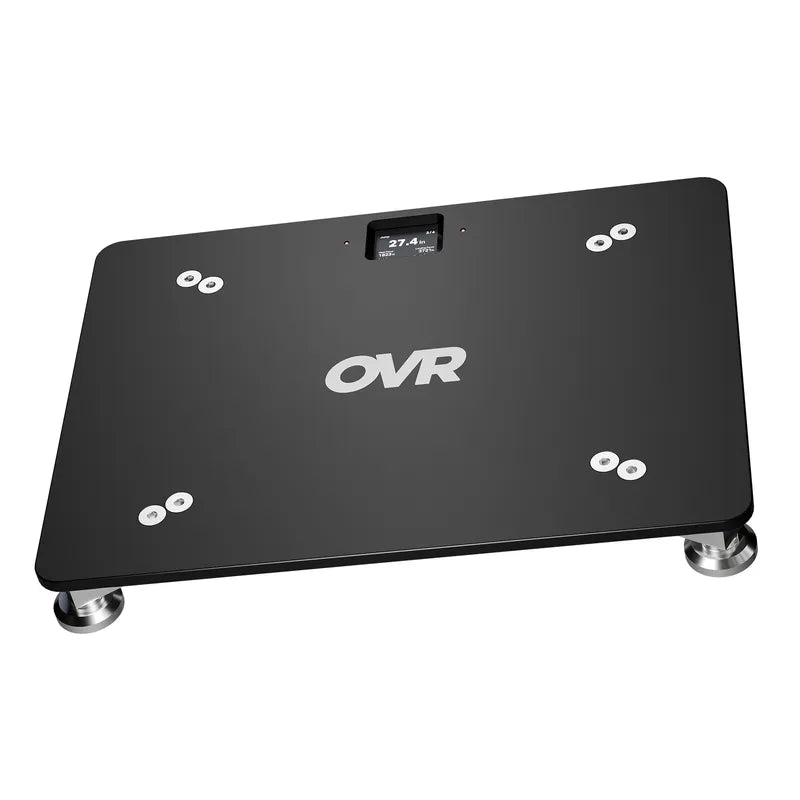
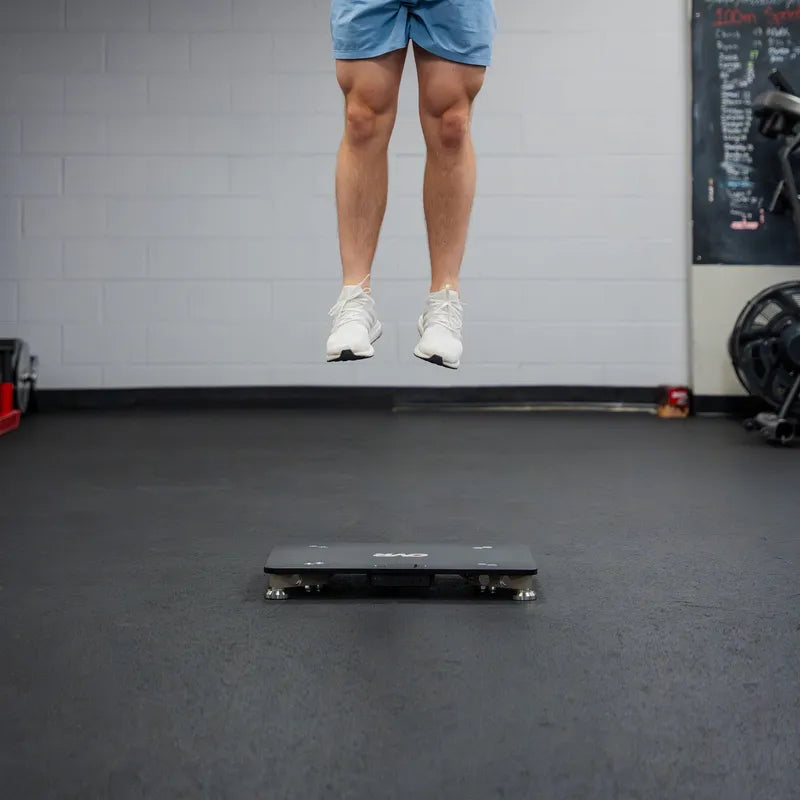


Contrast training means pairing a heavy lift with a set of jumps a few minutes later, then repeating that pairing through the session [11]. Compared with a straight strength program, athletes who train this way jump higher [1], change direction faster [3], and accelerate better over short distances, and they end up just as strong [2]. Those gains build over weeks. A single session does much less. A barbell velocity tracker shows how fast the bar is moving, which makes picking the right weight easier than working from a percentage chart.
Three qualities, one slot
Start with the jump, since most programs already test it. Athletes training this way added about an inch to their vertical over what heavy lifting alone produced, and it beat every other way of combining lifting and jumping [1]. A second review found the same [2]. An inch is real, and it is modest. The difference between strength and power explains why: heavy squatting already does most of the work on the jump by itself.
Changing direction is where the gap is widest. Across 42 studies, contrast training beat both heavy lifting alone and jump training alone, and by a wider margin than it produced on the vertical [3].
The speed benefit is limited to short distances. Five and twenty meter sprints improved, while thirty meters and beyond showed nothing [2]. That makes acceleration rather than top speed the thing to test if you want to know whether a block is working.
Strength does not suffer
Squat and bench press one-rep maxes, the heaviest weight an athlete can lift once, improved just as much whether athletes trained in contrast pairs or lifted straight through [2]. For a coach with one session and several qualities to develop, that is the argument: the jump work costs nothing on the strength side.
What the same-day boost actually adds
Do not expect a bigger jump that afternoon. The boost is small enough that researchers call it trivial, and it all but vanishes in athletes who warmed up properly [5]. Three trials found nothing beyond what a good warm-up already gives [6]. Plyometric jumps and hops produce a bigger same-day effect than barbell work anyway [5].
Running it
- Back squat, three sets of three to six reps at 85 percent of one-rep max [4]
- Three to five minutes of rest before the jumps [4, 7]
- Countermovement jumps, the standard dip and jump, at bodyweight [4], every rep maximal
- Three times a week, seven weeks or longer [2, 3]
Three to five minutes between the lift and the jumps is the usual prescription, and that window produced the largest effect [7]. Shorter works too. Under three minutes still produced a clear effect [7], and most trials that reported an interval used less than that, with sixty and ninety seconds common [4]. Only eight minutes or longer stopped working. When the clock is tight, alternate lift and jump with about ninety seconds between them.
The order is flexible, which is what makes this workable with a big group. Alternating lift and jump set by set, or doing all the heavy sets first and the jumps after, produced the same change of direction results [8]. With one rack and thirty athletes, send the whole group through the heavy sets, then move everyone to the jumps. Coaches pair a squat with vertical jumps, and a hip hinge such as a deadlift with horizontal jumps [9], so match the movement to the jump you want.
Bar speed cuts the work further. In one trial of thirty trained athletes, setting the heavy sets by bar speed instead of a fixed rep count produced the same squat gains on about 40 percent less total lifting, with a better jump result and lower reported effort [12].
Watching velocity numbers set to set keeps the heavy set from turning into a fatigue set, which is the most common way this goes wrong. A third rep slower than usual at the same weight means the athlete came in tired.
Where it fits
The best day for it is one where athletes come in fresh and a heavy lower-body lift is already scheduled. The jumps only work if they stay maximal after the heavy set. Steady training weeks are where it belongs, which rules out testing days and the days right after a game.
Coaches back it most for in-season use and dedicated power blocks, with the preseason close behind [9]. In season they settled on one session a week [9], so the three-a-week prescription above belongs to the off-season and preseason. Coaches tend to push the heavy set to 85 or 90 percent, but the trials that compared loads found 85 and below worked better [9, 10]. Stay at 85 unless the athlete is already very strong.
Contrast training builds three qualities at once: a higher vertical jump, faster change of direction, and quicker short sprints, with no cost to the squat or the bench. Give it time, and as part of a well-rounded annual plan you will see all three improve.
Sources
- Effects of combined resistance and plyometric training modalities on vertical jump and sprint: a systematic review and network meta-analysis. BMC Sports Science, Medicine and Rehabilitation, 2026: https://doi.org/10.1186/s13102-026-01531-0
- Effects of complex training compared to resistance training alone on physical fitness of healthy individuals: A systematic review with meta-analysis. Journal of Sports Sciences, 2024;42(14):1367-1389: https://doi.org/10.1080/02640414.2024.2391657
- The efficacy of complex training for enhancing change of direction ability: A systematic review and meta-analysis. International Journal of Sports Science and Coaching, 2025: https://doi.org/10.1177/17479541251386936
- What do we Know about Complex-Contrast Training? A Systematic Scoping Review. Sports Medicine Open, 2024: https://sportsmedicine-open.springeropen.com/articles/10.1186/s40798-024-00771-z
- Optimizing Post-activation Performance Enhancement in Athletic Tasks: A Systematic Review with Meta-analysis for Prescription Variables and Research Methods. Sports Medicine, 2025: https://link.springer.com/article/10.1007/s40279-024-02170-6
- Post-activation performance enhancement (PAPE) protocols do not further increase jumping performance beyond warm-up effects: findings from three acute randomized crossover trials. Frontiers in Physiology, 2024: https://www.frontiersin.org/journals/physiology/articles/10.3389/fphys.2024.1447421/full
- Post-activation potentiation enhancement induction strategies with different rest intervals on jump performance: a meta-analysis. Frontiers in Physiology, 2026: https://www.frontiersin.org/journals/physiology/articles/10.3389/fphys.2025.1696129/full
- Effect of Complex Contrast Training on Change of Direction Performance in Team-Sport Athletes: A Meta-Analysis. Applied Sciences, 2025: https://www.mdpi.com/2076-3417/15/13/7385
- Enhancing athletic performance with complex contrast training: A Delphi study of elite strength and conditioning coaches. International Journal of Sports Science and Coaching, 2024;19(6):2321-2333: https://doi.org/10.1177/17479541241272256
- Short-term adaptations following Complex Training in team-sports: A meta-analysis. PLOS ONE, 2017: https://journals.plos.org/plosone/article?id=10.1371/journal.pone.0180223
- Within Session Exercise Sequencing During Programming for Complex Training: Historical Perspectives, Terminology, and Training Considerations. Sports Medicine, 2022: https://link.springer.com/article/10.1007/s40279-022-01715-x
- Less training, better improvement: effects of velocity-based complex training on lower-limb maximal strength and explosive performance in highly-trained volleyball athletes. BMC Sports Science, Medicine and Rehabilitation, 2025;17:312: https://doi.org/10.1186/s13102-025-01364-3


