
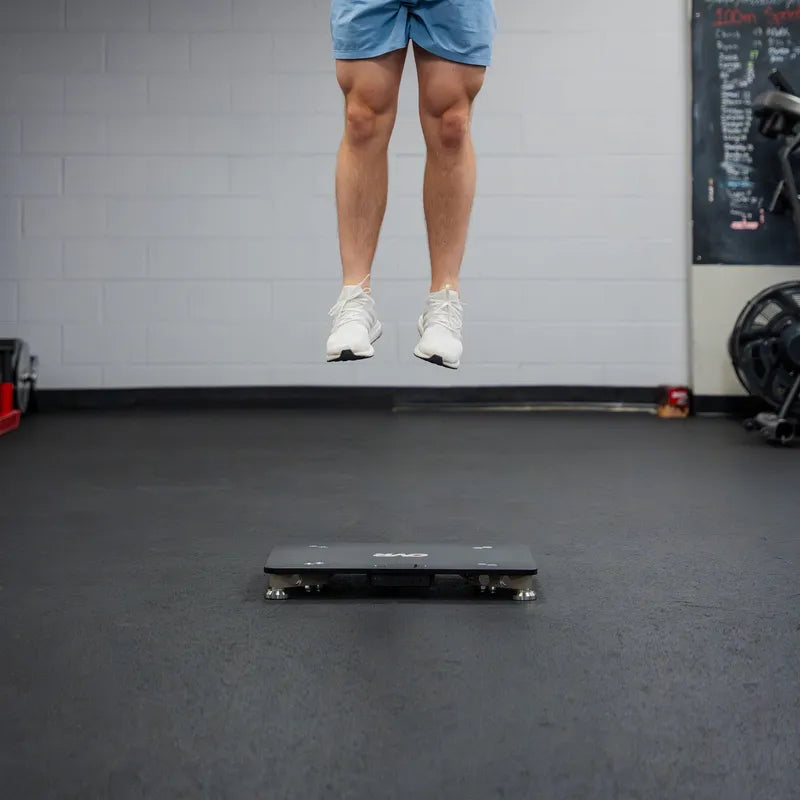


The eccentric utilization ratio (EUR) is one of the easiest force-plate numbers to calculate and one of the easiest to misread. It divides a countermovement jump (dip and rebound in one motion) by a squat jump (held squat, no dip), scored by jump height or sometimes peak power.
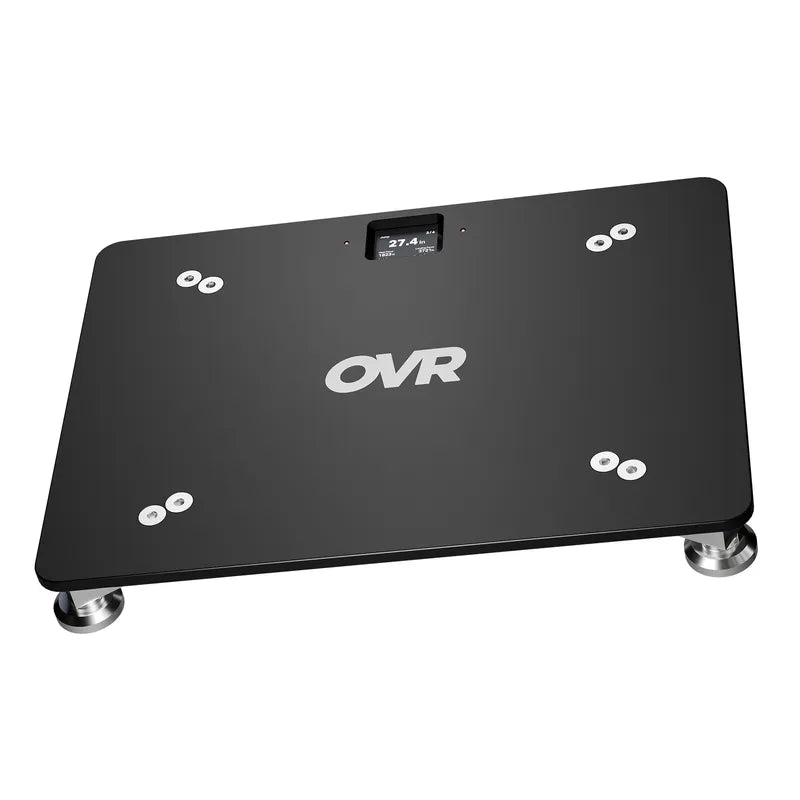
The ratio is meant to capture how much the athlete gains from that dip. But it is only trustworthy when the squat jump is collected cleanly, and that is hard to verify from jump height alone. That is why EUR belongs on force plates, which capture the full force behind the jump, not just the height.
What it measures
Almost everyone jumps higher with the dip than without it, and that gap is what EUR measures. Dipping down loads the muscles and tendons like a spring, and it gets the muscles firing before the push begins. A jump from a dead stop has neither, so it comes out lower. Coaches call this the stretch-shortening cycle. In most athletes the countermovement jump lands 5 to 15 percent above the squat jump, so EUR usually sits just above 1.0. That gain comes from the slow side of that cycle, a longer, unhurried dip, not the fast, springy side that reactive strength index testing measures.
One rule before you compare anyone: score every test the same way. You can build EUR from jump height or from power, and the two do not match. In one study, the same volleyball players scored 1.11 by jump height, 1.01 by peak power, and 1.40 by average power. For most coaches the right input is jump height: the one they already read, the one the benchmarks use, and the cleanest number a force plate gives you. Whichever you choose, hold it across every athlete and retest.
The squat jump decides whether the number is real
Collecting EUR comes down to the squat jump, the harder of the two to get clean. The athlete lowers to about a 90-degree knee bend, or their own countermovement-jump depth, holds dead still for two to three seconds, then jumps with no dip, hands on hips. Match that depth to the countermovement jump, or you are dividing two different movements.
The common failure is a small dip sneaking in before the jump. It happens in a split second, too fast to catch by eye. A jump mat only times how long the athlete is airborne, so it cannot tell a clean squat jump from a sloppy one. A force plate catches it: any sink before the jump drops the force reading below the athlete's bodyweight during the hold, and the rule of thumb is to throw out any rep that drops more than about 5 percent. That hidden dip is what quietly breaks the ratio.
Read both jumps before the ratio
A clean number can still fool you. Two athletes both land near 1.15: one jumps 23 inches (58 cm) in the countermovement jump and 20 inches (51 cm) in the squat jump, the other 15 and 13 inches (38 and 33 cm). Same ratio, nothing in common when you build their programs.
The part most coaches miss is which way the error runs. EUR is the countermovement jump over the squat jump, so a high score looks like a great countermovement jump, but a weak squat jump on the bottom pushes it up too. Across 313 athletes, the higher the EUR, the slower they were off a dead stop. A "good" EUR can mean a strong countermovement jump, or an athlete slow off a standstill. Only the two raw numbers tell you which. A clean countermovement jump test tells you more than the ratio you build on top of it.
Real benchmarks sit close to 1.0: height-based EUR runs about 1.11 in men, 1.08 in women. The popular "above 1.1 is good, below 1.0 means do plyos" lines are rules of thumb, not proven cutoffs.
What to do with it
Use EUR to decide where to look next, not to write the program by itself. Once you have confirmed the raw jumps, the response is simple. A low EUR from a genuinely weak countermovement jump, not a strong squat jump, points toward reactive, plyometric work, which depth jump training builds directly. A high EUR from a strong countermovement jump points toward pure strength and fast force from a dead stop.
Know its limits. Both jumps move around day to day, so a small slip in the squat jump swings the ratio: treat small changes as noise, not progress. On its own it predicts little. In the volleyball study, plain countermovement jump height told you how athletes performed, and the ratio added nothing. It helps most with athletes who start from a standstill: the sprint start out of blocks, the swim start off the wall, a lineman's first step off the snap. Collect both jumps cleanly, score them the same way, and read the raw numbers first. Done that way, EUR costs two or three minutes and points you to who needs a closer look. It is a flag, not a verdict.
Sources
- McGuigan et al. 2006 (origin, JSCR): https://journals.lww.com/nsca-jscr/abstract/2006/11000/eccentric_utilization_ratio__effect_of_sport_and.42.aspx
- Van Hooren & Zolotarjova 2017 (CMJ vs SJ mechanisms, JSCR): https://journals.lww.com/nsca-jscr/fulltext/2017/07000/the_difference_between_countermovement_and_squat.32.aspx
- Kozinc, Pleša, Šarabon 2021 "Questionable Utility" (IJERPH): https://pmc.ncbi.nlm.nih.gov/articles/PMC8623165/
- Kozinc et al. 2024 EUR vs SJ RFD (T&F): https://www.tandfonline.com/doi/full/10.1080/23335432.2024.2341634
- Kipp et al. 2021 joint-level EUR (Sports Biomech): https://pubmed.ncbi.nlm.nih.gov/30907707/
- Tufano et al. 2013 reliability (ASCA/ECU): https://ro.ecu.edu.au/ecuworks2013/280/
- Performance Predictors in Elite Athletes 2025 (Appl Sci): https://www.mdpi.com/2076-3417/15/14/7832
- Global Performance Insights, EUR Explained: https://www.globalperformanceinsights.com/post/the-eccentric-utilization-ratio-eur-explained
- Sportsmith, Assessing plyometric and jump ability: https://www.sportsmith.co/articles/assessing-plyometric-and-jump-ability/
- Science for Sport, Force Plates overview: https://www.scienceforsport.com/force-plates-what-are-they-and-what-insights-do-they-provide-coaches/
- Science for Sport, Dynamic Strength Index: https://www.scienceforsport.com/dynamic-strength-index/
- Relentless Performance, Fast vs Slow SSC: https://relentlesspt.com/the-fast-and-slow-stretch-shortening-cycle-what-athletes-need-to-know/


