


OVR Jump measures the output of a jump. OVR Force measures the mechanics behind it. From one jump, OVR Jump reports three numbers; OVR Force breaks the same jump into 20+. A laser-based jump tester and a portable force plate system are not competing tools, and the real question is when to use each. For most programs, the answer is both.
They overlap on the headline numbers: both report jump height and reactive strength index, on the same standing-referenced scale [1][2]. Past those shared numbers, they separate.
What OVR Jump measures
OVR Jump is a laser-based sensor: a sender and a receiver set a few feet apart create a laser barrier at ground level, and the athlete jumps through it so the system detects takeoff and landing. It works on any surface with a clear laser path, including turf, concrete, a gym floor, or a track. Results show on the receiver's own display, so no phone or tablet is required to test.
It reports three things, split across Vertical, RSI, and GCT modes: jump height, ground contact time, and reactive strength index. Those are the output. Run the same vertical jump test each week and the trend shows whether an athlete's explosiveness is climbing or slipping over a block. A steady climb across several tests means the training is working. A flat or falling number flags a change, whether fatigue, a stalled program, or something outside training, though the height alone will not say which.
The draw for a coach is portability. The receiver weighs 1.2 pounds and the sender under half a pound; both fit in the included carry bag, and the whole setup drops into a standard backpack, ideal for road trips and combines. Tether up to five receivers to widen the jumping zone, and with no reset between athletes a large group moves through fast.
What OVR Force measures
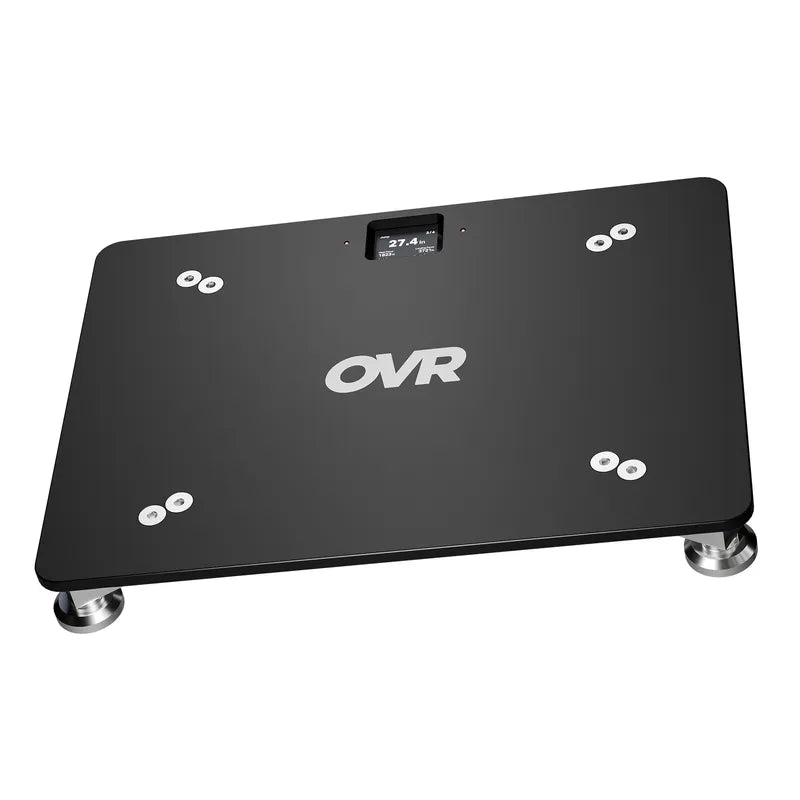
OVR Force is a standalone force plate that samples at 1,000 Hz with 1 N resolution (0.22 lb), the same sampling rate the pro-level plates use. Like OVR Jump, it runs without a phone and shows results on the plate itself. The difference is in what it records between step-on and landing.
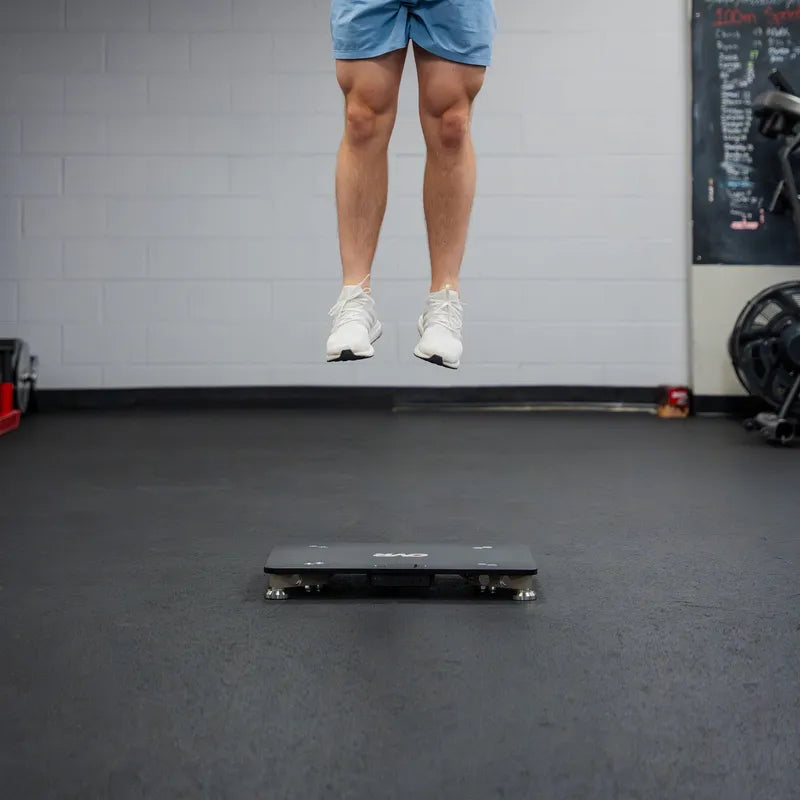
In Jump Mode it captures a full CMJ, drop jump, or squat jump and breaks the movement into phases: unweighting, braking, propulsive, takeoff, flight, landing, and stabilization. Each phase produces metrics that explain the jump rather than report it, from countermovement depth and braking RFD to propulsive impulse, asymmetry, and landing force. Force plates are the reference standard for this because the trace shows how the athlete organized the jump, not only the result [3][4][5].
In practice, two athletes can post the same vertical in opposite ways. One sinks into a deep countermovement and pushes for longer, which shows up as a high propulsive impulse, the strongest single predictor of jump height [6]. The other barely dips and springs off the ground fast, which shows up as a high modified reactive strength index (mRSI), the mark of an elastic, reactive jumper. The number is identical on a jump tester; a force plate shows both strategies and any imbalance behind them.
That imbalance is often the first thing to check after an injury. On a dual plate, the braking phase usually shows the gap before propulsion or landing does, which makes braking asymmetry the number to lead with in force-plate return-to-play testing [7][8].
OVR Force is not limited to jump testing. Force and Free Modes handle standing and non-standing isometrics like the mid-thigh pull, which give a clean read on maximal strength and how fast an athlete builds force. Paired with the jump, that answers something the jump alone cannot: whether an athlete is strong but slow to turn it into a jump, or explosive but short on raw strength. The first case points to ballistic and plyometric work, the second to heavier strength training.
The two read jump height differently. OVR Jump times the air between the lasers; OVR Force reads the force underfoot, defaulting to take-off velocity and falling back to flight time when the weigh-in is not clean. Both keep the plantar-flexion rise in, so they read on the same scale as each other, and higher than plates that measure from takeoff [9].
Side by side
| OVR Jump | OVR Force | |
|---|---|---|
| What it answers | How high, how fast off the ground | Why the jump looked the way it did |
| Method | Laser takeoff and landing detection | Force plate, 1,000 Hz sampling |
| Core metrics | Jump height, RSI, ground contact time | Jump height, mRSI, depth, time to takeoff, peak propulsive force, propulsive impulse, power, braking RFD, braking asymmetry, landing force (the primary CMJ set; 21 in all from one jump) |
| Asymmetry (left vs right) | Senses the whole athlete, not each leg | Yes, per phase (dual plate) |
| mRSI | Needs on-plate force sensing | Yes |
| Strength and isometric testing | Focused on jumps | Yes (IMTP and other isometrics) |
| Jump height basis | Center of mass, standing reference (Vertec-aligned) | Center of mass, standing reference (Vertec-aligned) |
| Weight | ~1.6 lb total (receiver + sender) | 31.8 lb per plate |
| Portability | Fits in a standard backpack, comes with a carry bag, fast to set up and move | Best at a fixed station, but moves easily with a carry handle |
| Large groups | Well suited; cycles a full roster fast, one athlete at a time | One athlete at a time; better for individual testing than mass roster runs |
| Phone required | No | No |
| Subscription | None | None |
When to reach for each
Reach for OVR Jump when the question is how much. Weekly or biweekly output testing across a full roster, travel to a combine or a road game, a quick readiness check before practice, or dropping a standing or approach vertical into a superset so the instant feedback drives intent and effort. It is fast and light, and it measures every jump type, from standing verticals to running approach jumps, switching between jump height, RSI, and ground contact time on the device.
Reach for OVR Force when the question is why. A vertical that has stalled for two months despite a rising squat. A return-to-play decision that hinges on left-right symmetry. An athlete whose jump looks fine but whose landing does not. The force-time trace answers these: it separates a strength ceiling from a rate-of-force problem, shows which leg is doing less, and reads how the athlete lands, so the fix targets the real deficit, not the height alone. It also catches fatigue early, before the jump number falls [10].
There is real overlap. OVR Force measures jump height and RSI too, and a countermovement jump takes seconds on it, so this is not quick versus slow. It is reach versus depth. OVR Jump costs far less, fits in a backpack, and handles approach and running jumps a plate cannot, which makes it the tool for testing a whole roster or leaving out for athletes to chase the vertical jump number. OVR Force trades that portability for the full force-time trace and isometric strength testing. So use OVR Jump as the everyday output check, and bring in OVR Force when a number moves, stalls, or a real decision depends on it. Both run standalone, skip the subscription, and feed the same OVR ecosystem, so you get the result and the reason from one system.
Sources
- Concurrent Validity of Countermovement and Squat Jump Height Assessed With a Contact Mat and Force Platform in Professional Soccer Players, Frontiers in Sports and Active Living (2024): https://www.ncbi.nlm.nih.gov/pmc/articles/PMC11263071/
- The Agreement Between a Portable Contact-Mat and Force-Plates During Bilateral Vertical Jumps, PMC: https://pmc.ncbi.nlm.nih.gov/articles/PMC9365114/
- Countermovement Jump Force-Time Curve Analyses: Reliability and Comparability Across Force Plate Systems, Journal of Strength and Conditioning Research (2024): https://journals.lww.com/nsca-jscr/abstract/2024/01000/countermovement_jump_force_time_curve_analyses_.4.aspx
- Everything You Need to Know About the Countermovement Jump on Force Plates, SimpliFaster: https://simplifaster.com/articles/countermovement-jump-force-plates-guide/
- Countermovement Jump (CMJ), Science for Sport: https://www.scienceforsport.com/countermovement-jump-cmj/
- Relative Net Vertical Impulse Determines Jumping Performance (Kirby et al.), Journal of Applied Biomechanics (2011): https://pubmed.ncbi.nlm.nih.gov/21844609/
- Interlimb Asymmetries: Magnitude or Direction? Understanding Interlimb Asymmetry (Bishop et al.), PubMed: https://pubmed.ncbi.nlm.nih.gov/32149878/
- A Countermovement Jump for the Midterm Assessment of Force and Power Exertion After Anterior Cruciate Ligament Reconstruction, American Journal of Physical Medicine and Rehabilitation: https://doi.org/10.1097/phm.0000000000001954
- The Battle of the Equations: A Systematic Review of Jump Height Calculations Using Force Platforms: https://pmc.ncbi.nlm.nih.gov/articles/PMC11561012/
- Analyzing the Impact of Various Jump Load Intensities on Countermovement Jump Metrics, PMC: https://pmc.ncbi.nlm.nih.gov/articles/PMC11722855/


