
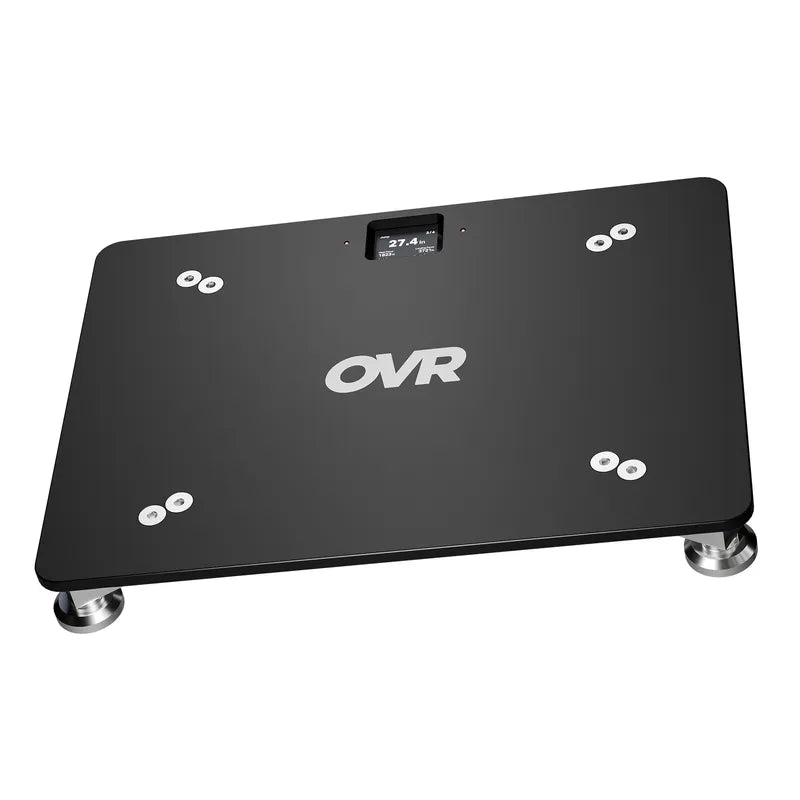



Average bar speed and peak bar speed come off the same rep, but they answer different questions. Average tells you how heavy the lift really was. Peak tells you how explosive it was. Both are useful, and the one to use depends on the day's work. A barbell velocity tracker records both, so it comes down to knowing which number fits what you are training [1].
Two numbers off the same rep
Average bar speed is the average velocity of the bar through the concentric, the way up, from the moment it leaves the bottom to lockout. Peak bar speed is the single fastest instant of that same rep. Peak is always the higher number, because it reports one moment instead of the whole lift [2].
Each one tracks something different. Average shows the load: a heavier bar moves slower through the whole rep, so the average drops. Peak shows the speed, how fast the bar was moving at its best. On a heavy squat the two numbers stay close together. On the light, fast reps used for speed and power work, they spread far apart, because the bar hits a high peak mid-rep and then slows before lockout, which pulls the average down [2]. Both came off the same rep, and each answers a question the other cannot.
Average: how heavy the rep really was
Average is the number that maps to load, which is what makes it the backbone of velocity based training. Bar speed falls as load climbs, and for the main barbell lifts that relationship is close to linear from roughly 30 to 100 percent of 1RM [3]. Average velocity tracks that line most tightly. A 2018 study comparing velocity variables in the bench press found the average across the concentric measured relative load most accurately, ahead of peak [4, 5].
A given average speed lines up with about the same percentage of a lifter's max, session after session. That also makes it a readiness check: if a familiar weight moves slower than usual, the athlete is more fatigued than normal, and it is a cue to drop the load. Near a true 1RM squat, average bar speed sits around 0.30 m/s, fresh or grinding [6, 7]. The velocity zones you train in are set in average terms, and velocity loss, the percentage drop in speed across a set, is measured off average too [8, 9, 10]. Anything built on intensity runs on this number.
Peak: how explosive the rep was
Peak is the number that captures top-end speed. On the explosive lifts in a speed or power session, moved with a light load and full acceleration, that speed is the goal, so peak velocity is the better number there [2]. That covers loaded jump squats, bench throws, and the speed-focused Olympic lift derivatives, where the bar or dumbbell is still accelerating hard at the top of the movement [11, 12]. On loaded dumbbell jumps or similar speed work, peak shows the explosiveness that average smooths over [13].
Peak is also a consistent number from session to session [4], which makes it a steady target. An athlete chasing the highest peak on a jump squat or a bench throw has a clear mark to beat, and that visible number drives the intent that makes explosive work pay off [7].
Which number to train off
Match the number to the work. For basic strength and hypertrophy work, and really anything programmed off velocity zones or set-to-set velocity loss, use average. For explosive lifts like jump squats, bench throws, and the Olympic lifts and their variations, use peak. Set one as the main number for the session, and the other still shows on screen alongside it, with the spoken feedback following whichever you make primary.
One thing to keep straight. Because peak is always the higher of the two, holding a peak number up against an average target makes a lifter look faster than they are. If a number comes in well above target and the reps did not feel that quick, check which metric is showing before loading more plates. Both are honest numbers off the same rep. Use average to manage load and peak to chase speed, and let the day's goal decide which one leads.
Sources
- Validity, Reliability, and Sensitivity of a Commercially Available Velocity Measuring Device: https://pmc.ncbi.nlm.nih.gov/articles/PMC11581383/
- Mean, Peak and Mean Propulsive Velocity (GymAware): https://gymaware.com/do-you-need-mean-propulsive-velocity/
- Movement Velocity as a Measure of Loading Intensity in Resistance Training (Int J Sports Med, 2010): https://pubmed.ncbi.nlm.nih.gov/20180176/
- Mean Velocity vs. Mean Propulsive Velocity vs. Peak Velocity: Which Variable Determines Bench Press Relative Load With Higher Reliability? (JSCR, 2018): https://pubmed.ncbi.nlm.nih.gov/28557855/
- Load-Velocity Relationships and Predicted Maximal Strength: A Systematic Review of Validity and Reliability: https://pmc.ncbi.nlm.nih.gov/articles/PMC9612483/
- An Applied Guide to Velocity Based Training for Maximal Strength (Sportsmith): https://www.sportsmith.co/articles/an-applied-guide-to-velocity-based-training-for-maximal-strength/
- Velocity-Based Training (Science for Sport): https://www.scienceforsport.com/velocity-based-training/
- OVR Velocity-Based Training Guide (internal reference)
- The Acute and Chronic Effects of Velocity Loss Thresholds During Resistance Training: A Systematic Review and Meta-Analysis (Sports Medicine, 2023): https://link.springer.com/article/10.1007/s40279-022-01754-4
- Effects of Velocity Loss During Resistance Training on Athletic Performance, Strength Gains and Muscle Adaptations (Scand J Med Sci Sports, 2017): https://onlinelibrary.wiley.com/doi/10.1111/sms.12678
- The Load-Velocity Relationship in the Jump Squat Exercise: https://pmc.ncbi.nlm.nih.gov/articles/PMC10108764/
- Reliability Assessment of Ballistic Jump Squats and Bench Throws: https://pubmed.ncbi.nlm.nih.gov/15705042/
- Mean Propulsive Velocity vs Peak Velocity (Vitruve): https://vitruve.fit/blog/differences-mv-pv/


