
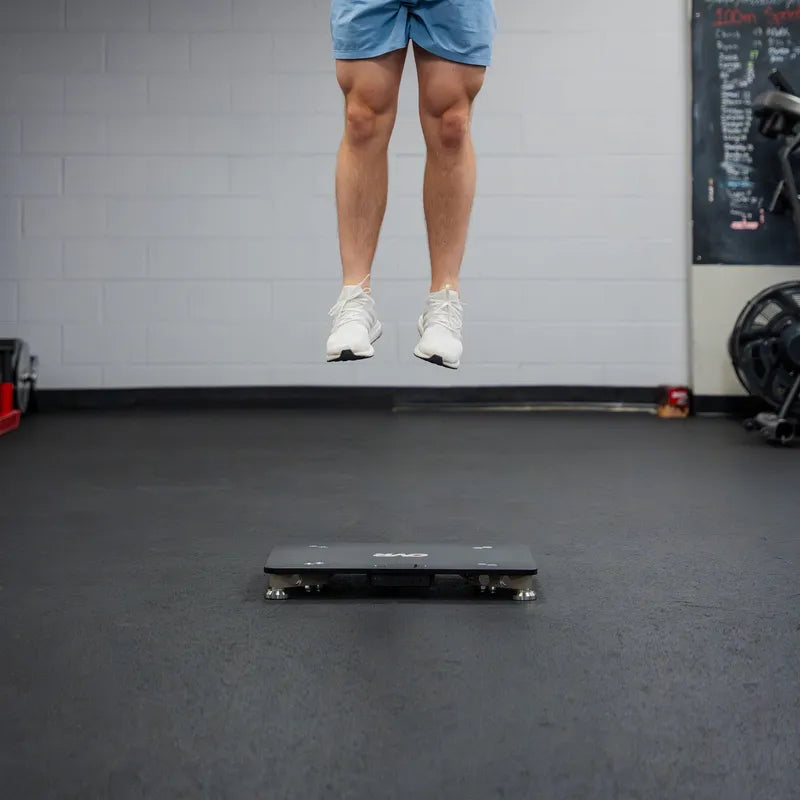


Asymmetry is one of the most useful things a force plate gives a coach: limb by limb, on every rep. It shows where an athlete is balanced and where they are not. A jump splits into phases (braking on the way down, propulsion on the way up, then landing), and with two plates you can read the left-right gap in each. It is worth leading with the braking phase, since a deceleration gap tends to show up earliest, which makes it the best single read if you only track one. Read it directionally, which leg and by how much, against the athlete's own baseline. The skill is simple to learn: know which readings to act on now and which to keep watching, and every number you collect starts improving your programming.
Where the 10 percent line comes from, and a better reference
You will hear a 10 percent rule: under it is fine, over it is a problem. It is a handy starting point, but it is borrowed convention rather than a validated cutoff. A systematic review of 53 studies found 15 of 18 that used an "abnormal" threshold set it at 10 to 15 percent, most without citing evidence. The good news is you have something better than a generic line: the athlete in front of you.
Healthy, uninjured athletes often sit above 10 percent and are completely fine. In adolescents with no injury history, landing-force asymmetry on a countermovement jump averaged about 20 percent, and around 16 percent on a drop jump, in clean knees. That is exactly why the athlete's own baseline beats a one-size line: it tells you what normal looks like for them, so a real change stands out. The question worth asking is not "is this above 10 percent," it is "is this above normal for this athlete on this test."
Make the reading rock solid
A force plate gives you a precise number, and a couple of habits make it a dependable one. Take a few trials and average them, and compare against the athlete's baseline rather than a single day. Single-leg tests expose more of a gap, bilateral tests measure it more repeatably, so use each for its strength: the bilateral jump for quick, reliable weekly monitoring, the single-leg test when you want the true limb-by-limb read.
It also helps to know that the index matters. More than a dozen asymmetry formulas exist and they do not all return the same number, so pick one and stay with it. With a baseline and a couple of trials, you can tell a real shift from normal trial-to-trial swing at a glance.
When to act, with confidence
Asymmetry is most powerful when you act on the readings that clear three checks: the gap is bigger than that athlete's normal test-to-test variation, it shows up on the same side across sessions, and it sits on a limb that is also weak in absolute terms. Clear all three and you have a high-confidence target. Until then, the right move is to keep watching.
The third check adds the most, because the underlying force fills in what the ratio cannot. Take two athletes who both read about 9 percent braking asymmetry. The first is modest on both legs and needs general work across the board. The second is strong on both, putting more force through their weaker leg than the first manages on either, so their gap is a fine-tuning target, not an alarm. Same percentage, two very different and useful answers, because you read the force behind the ratio, not just the number.
The context where a fixed threshold matters most
Return to play after a serious knee injury is where a symmetry criterion truly shines. In the Delaware-Oslo cohort after ACL reconstruction, passing a 90 percent quadriceps strength symmetry cut and waiting at least nine months both sharply lowered reinjury risk, and each 1 percent below that mark raised it by roughly 3 percent. Here the number predicts something real and protects the athlete, which is exactly why criterion-based return to play is built around it.
Read it in context, just like any asymmetry number. A pre-injury baseline is gold, since the uninvolved limb can decondition during rehab and flatter the comparison, and different tests highlight different parts of recovery, so a battery beats any single test. Symmetry is one of several criteria here, and the clearance call belongs to the medical team. Used that way, it is one of the most trustworthy numbers in the whole return.
What to do with a meaningful gap
A reading sorts cleanly into three constructive actions: keep watching, address, or refer. Most sit in keep watching: stay on your normal testing schedule and let the trend confirm itself. When a gap clears all three checks and the athlete is healthy, address it with unilateral work: split squats, single-leg RDLs, step-ups, single-leg jumps. Train the weak limb first while it is fresh and match the strong limb's volume to what the weak one can handle. Unilateral plyometric training has meta-analytic support for reducing lower-limb asymmetry, so the work pays off and you can watch the gap close on the plate.
One principle keeps the work honest: the goal is always two capable limbs. Building the weak side up is the win, and you never want to shrink a gap by letting the strong side regress. And if a gap shows up with pain, a recent injury, or a movement that looks off, that is a referral, which is the right and easy call.
Reading asymmetry so it works for you
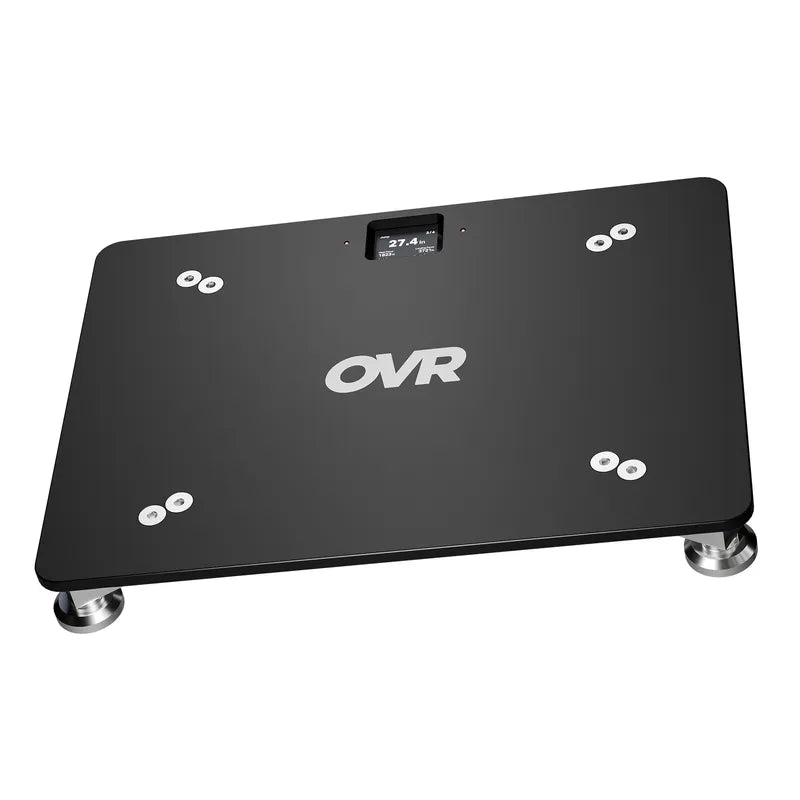
Asymmetry earns its place when you read it against the athlete's own baseline and trend, note which phase the gap sits in and which way it leans, and confirm it beats their normal swing before you program for it. Read that way, it is one of the most actionable numbers a force plate gives you, and it reads even better as part of a broader athletic profile than as any single metric. It takes testing the same athletes often enough to build a baseline. That is where the OVR Force fits. It tests in seconds, and the free OVR Connect app keeps the history, so a re-test costs nothing and the baseline is always there to compare against. Get in that rhythm and asymmetry stops being a percentage you wonder about and becomes a signal you can coach with.
Sources
- Parkinson et al. 2021 (calculation, thresholds and reporting of strength asymmetry, systematic review): https://pmc.ncbi.nlm.nih.gov/articles/PMC8488821/
- Heishman et al. 2019 (CMJ inter-limb asymmetry, NCAA D1 basketball): https://pmc.ncbi.nlm.nih.gov/articles/PMC6572434/
- Szabó et al. 2025 (does the 10% threshold matter, basketball): https://pmc.ncbi.nlm.nih.gov/articles/PMC12641735/
- Pérez-Castilla et al. 2021 (between-session reliability, unilateral vs bilateral CMJ): https://pmc.ncbi.nlm.nih.gov/articles/PMC8323888/
- Test-Retest Reliability of Magnitude and Direction of Asymmetry (CMJ/DJ/CMRJ), MDPI Symmetry 2023: https://www.mdpi.com/2073-8994/15/10/1960
- Cross-task asymmetry agreement, adolescent soccer (single-leg CMJ vs 505): https://pmc.ncbi.nlm.nih.gov/articles/PMC8037528/
- Guan et al. 2022 (inter-limb asymmetry vs sport injury, 28 prospective cohorts): https://pmc.ncbi.nlm.nih.gov/articles/PMC8779786/
- Fox et al. 2023 (asymmetry vs athletic performance meta-analysis): https://pmc.ncbi.nlm.nih.gov/articles/PMC10249853/
- Bishop et al. 2019 (jumping asymmetries vs speed/COD, academy soccer): https://pubmed.ncbi.nlm.nih.gov/30707141/
- Raya-González et al. 2020 (asymmetries NOT associated with performance, U15 soccer): https://pmc.ncbi.nlm.nih.gov/articles/PMC7063114/
- Zifchock et al. 2008 (the symmetry angle): https://pubmed.ncbi.nlm.nih.gov/17913499/
- Bishop, Read, Chavda, Turner 2018 (how to calculate inter-limb asymmetries, Strength Cond J): https://journals.lww.com/nsca-scj/fulltext/2018/08000/interlimb_asymmetries__understanding_how_to.1.aspx
- VanZile et al. 2021 (normative landing kinetic symmetry, uninjured adolescents): https://pmc.ncbi.nlm.nih.gov/articles/PMC8329325/
- Grindem et al. 2016 (Delaware-Oslo, 90% quad strength symmetry plus timing, reinjury): https://pmc.ncbi.nlm.nih.gov/articles/PMC4912389/
- Wellsandt et al. 2017 (LSI overestimates knee function): https://pubmed.ncbi.nlm.nih.gov/28355978/
- Kotsifaki et al. 2022 (hop-distance symmetry masks knee biomechanics): https://pubmed.ncbi.nlm.nih.gov/33687928/
- Science of Multi-Directional Speed (Bishop framework, four-quadrant, baselines, RTP): https://sciofmultispeed.com/assessing-inter-limb-asymmetries-should-we-bother/
- SimpliFaster, Functional vs Nonfunctional Asymmetries: https://simplifaster.com/articles/determining-functional-vs-nonfunctional-asymmetries/
- SimpliFaster, Practical Guide for Using Force Plates: https://simplifaster.com/articles/force-plates-practical-guide/
- Science for Sport, Force Plates insights for coaches: https://www.scienceforsport.com/force-plates-what-are-they-and-what-insights-do-they-provide-coaches/
- Unilateral plyometric training reduces lower-limb asymmetry (meta-analysis): https://www.ncbi.nlm.nih.gov/pmc/articles/PMC12014563/
- Targeted unilateral training, weak-limb-first, basketball (proof-of-concept): https://www.ncbi.nlm.nih.gov/pmc/articles/PMC11234801/


