


Test the same athlete twice in one week with no training in between and the two numbers most likely will not match. Repeat tests typically differ by about 5 percent, which is more than an inch on a 30-inch vertical [1]. So an athlete can finish eight weeks of training, jump an inch higher, and still not know whether the program did it or it was just a good day.
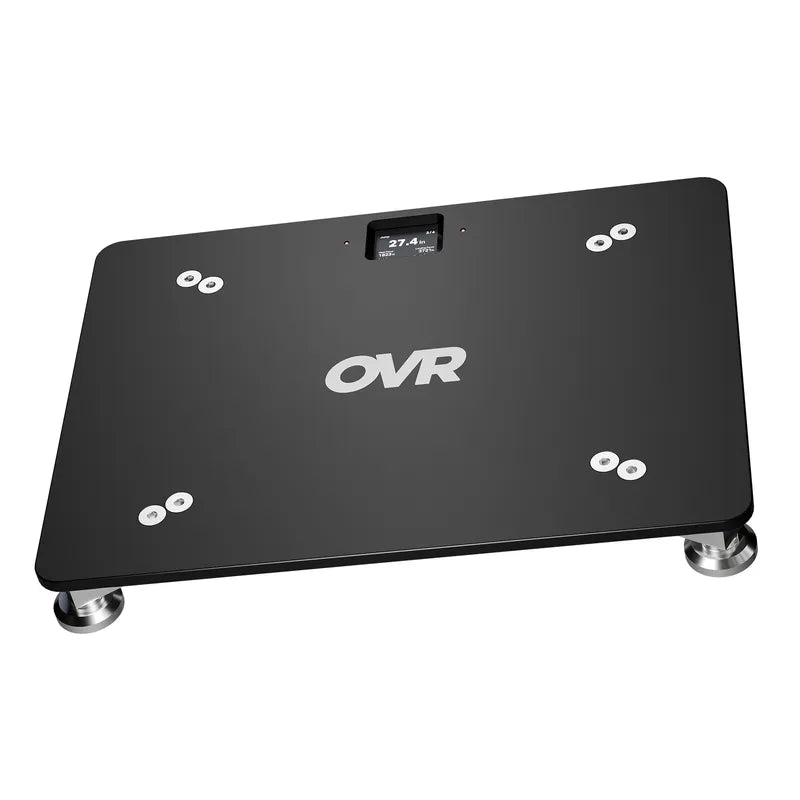
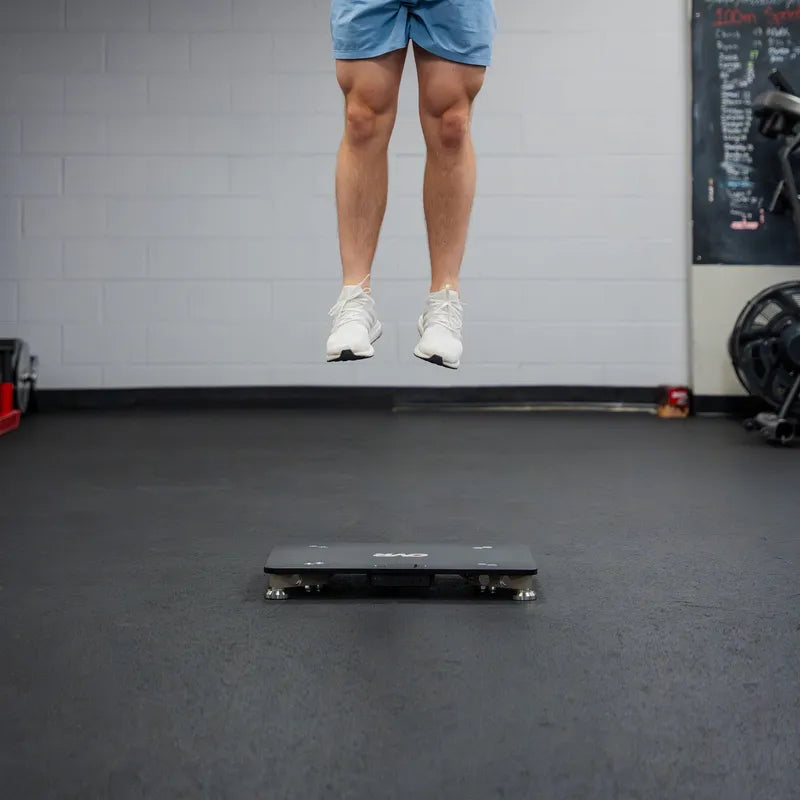
Many things feed a vertical jump. Three have the most evidence behind them. What each one is worth depends on the athlete: the one that adds inches to a weak jumper can do little for a strong one. Finding which one an athlete needs, and proving the training worked, takes consistent, standardized measurement. A laser jump tester on the floor gives you that.
The three things with the most evidence
1. Getting stronger. For an athlete who is not strong yet, nothing adds more. Athletes who added lifting and jump training averaged a little over an inch more than those who did no training at all [2]. The returns shrink as they get stronger. Squat strength explains about half the difference in jump height between athletes, and less of it at the top end [3]. Barbell strength tracks jumping closely in basketball players and shows no link in people with no lifting background [4].
2. Jump training. Plyometrics means hops, bounds and depth jumps done with as little time on the ground as possible. Across the trials it raised jump height by 5 to 9 percent depending on the jump tested [5], and it keeps working in athletes who already train hard [6]. Sprinting meets the same definition, and both sprinting and sled work transfer to jumping [7, 8]. The biggest gains came from blocks longer than 10 weeks using more than 50 jumps a session [9], so the limit is how many jumps per week an athlete can handle.
3. The jump itself. Part of a vertical jump is coordination, and small changes in how an athlete jumps move the number. A full arm swing contributed about 1.9 inches, roughly 13 percent of the jump [10], and a deeper countermovement added about three quarters of an inch in a single session [11]. Coaches who train jumpers say the same, calling technique the fastest way to add inches [12] and pointing to the second-to-last step of the approach as the part that matters most [13]. Technique ranks third because the fix happens once, though it is the first thing to check, since looking costs nothing.
Which one is holding you back
Three checks narrow it down, none of them longer than a few minutes. Run them in order, since the third only means something once the second is settled.
The first is the gap between a standing jump and a running one. Test both and subtract. On one team the gap ran from zero to five inches across five players [14]. A gap near zero means the run-up is not turning speed into height, so train short-contact hops, landing drills and full-speed approaches. A gap of four or five inches suggests the run-up is already doing its job. The standing jump is then what has to come up [14].
The second is strength against body weight, which accounts for much of a standing jump. The weaker an athlete is for their size, the more likely strength is the answer, and the less it returns once they are strong [3]. Heavy lifting does most of the work here, and pairing those lifts with jumps has produced a little more jump height than lifting by itself [15].
The third is ground contact. Reactive strength index divides jump height by the time the feet spend on the floor in a drop jump. An athlete who is already strong and still slow off the floor needs low-volume rebound work [16]. In a weaker athlete the number rises on its own as strength comes up, so run this check after the second one [16].
Running a block and judging it
Baseline is three jumps, averaged and measured the same way every session. Keep the time of day and the surface the same, since output swings by up to 5 percent between morning and afternoon [17]. Working from the average of three, the smallest change you can be confident in is about 6 percent [18], which works out to roughly two inches on a 30-inch vertical. Using only the best of the three pushes that threshold higher [18].
Testing weekly is still worth doing, since it tracks readiness and fatigue. Judging a block is a different question, and these tests hold up as sensitive measures across an eight-week span [18]. In youth athletes, four weeks, eight sessions and about 90 jumps a week is roughly the smallest dose that produced a measurable change [19]. In female athletes, blocks past 10 weeks produced considerably larger gains than shorter ones [20].
The average gain from a structured plyometric block is about 1.5 inches [9], which is less than a 30-inch jumper needs to clear that threshold. Give a first block 10 weeks or more before asking whether it worked.
The training goes to the one the checks pointed at, while the other two hold steady and the testing keeps running. The average of three jumps at the end decides the next move: a change above the threshold means staying with it, and a change below it means one of the other two gets the next block.
Sources
- Cormack SJ, Newton RU, McGuigan MR, Doyle TLA (2008). Reliability of Measures Obtained During Single and Repeated Countermovement Jumps. International Journal of Sports Physiology and Performance, 3(2), 131-144. https://doi.org/10.1123/ijspp.3.2.131
- Brandt M, Beinert S, Alfuth M (2023). Network Meta-analysis of Combined Strength and Power Training for Countermovement Jump Height. International Journal of Sports Medicine. https://doi.org/10.1055/a-2105-0540
- Keiner M, et al. (2025). Do small samples bias the correlation between strength and jump performance? Multivariate insights into age and sex amidst strength saturation: an analysis of 1,544 participants from different sports. Biology of Sport, 42(2), 3-11. https://doi.org/10.5114/biolsport.2025.139858
- Schiemann S, Keiner M, Wirth K, Lohmann LH, Wagner CM, Behm DG, Warneke K (2024). The magnitude of correlation between deadlift 1RM and jumping performance is sports dependent. Frontiers in Sports and Active Living, 6, 1345213. https://doi.org/10.3389/fspor.2024.1345213
- Markovic G (2007). Does plyometric training improve vertical jump height? A meta-analytical review. British Journal of Sports Medicine, 41(6), 349-355. https://doi.org/10.1136/bjsm.2007.035113
- Sun J, et al. (2025). Effects of plyometrics training on lower limb strength, power, agility, and body composition in athletically trained adults: systematic review and meta-analysis. Scientific Reports, 15, 34146. https://doi.org/10.1038/s41598-025-10652-4
- Markovic G, Jukic I, Milanovic D, Metikos D (2007). Effects of Sprint and Plyometric Training on Muscle Function and Athletic Performance. Journal of Strength and Conditioning Research, 21(2), 543-549. https://doi.org/10.1519/R-19535.1
- Li C, Chen L, Zhang Q (2025). Effects of resisted sprint training on sprint, jump, and change-of-direction performance in athletes: a systematic review and meta-analysis. Frontiers in Physiology. https://doi.org/10.3389/fphys.2025.1711992
- Saez-Saez de Villarreal E, Kellis E, Kraemer WJ, Izquierdo M (2009). Determining Variables of Plyometric Training for Improving Vertical Jump Height Performance: A Meta-Analysis. Journal of Strength and Conditioning Research, 23(2), 495-506. https://doi.org/10.1519/JSC.0b013e318196b7c6
- Yamashita D, Henderson FJ, Ishida Y (2025). Assessing the Contribution of Arm Swing to Countermovement Jump Height Using Three Different Measurement Methods in Physically Active Men. Biomechanics, 5(3), 45. https://doi.org/10.3390/biomechanics5030045
- Sanchez-Sixto A, Harrison AJ, Floria P (2018). Larger Countermovement Increases the Jump Height of Countermovement Jump. Sports, 6(4), 131. https://doi.org/10.3390/sports6040131
- THP Strength. How Much Did This Athlete Change His Technique To Break The World Record 53 Inches. Podcast transcript. https://thpstrength.transistor.fm/episodes/how-much-did-this-athlete-change-his-technique-to-break-the-world-record-53-inches/transcript
- adidas. Vertical jump training with Paul Fabritz. https://www.adidas.com/us/blog/605130
- Sportsmith. Using the approach vertical jump for athlete monitoring and training. https://www.sportsmith.co/articles/using-the-approach-vertical-jump-for-athlete-monitoring-and-training/
- Zhao C, Zhu Y, Zhang Y (2026). Effects of combined resistance and plyometric training modalities on vertical jump and sprint: a systematic review and network meta-analysis. BMC Sports Science, Medicine and Rehabilitation. https://doi.org/10.1186/s13102-026-01531-0
- THP Strength. Improving This Could Get You Jumping Higher FAST. Podcast transcript. https://thpstrength.transistor.fm/episodes/improving-this-could-get-you-jumping-higher-fast/transcript
- Taylor KL, Cronin J, Gill ND, Chapman DW, Sheppard J (2010). Sources of Variability in Iso-Inertial Jump Assessments. International Journal of Sports Physiology and Performance, 5(4), 546-558. https://doi.org/10.1123/ijspp.5.4.546
- Venegas-Carro M, Kramer A, Moreno-Villanueva M, Gruber M (2022). Test-Retest Reliability and Sensitivity of Common Strength and Power Tests over a Period of 9 Weeks. Sports, 10(11), 171. https://doi.org/10.3390/sports10110171
- Ramirez-Campillo R, et al. (2023). Plyometric-Jump Training Effects on Physical Fitness and Sport-Specific Performance According to Maturity: A Systematic Review with Meta-analysis. Sports Medicine - Open, 9, 23. https://doi.org/10.1186/s40798-023-00568-6
- Stojanovic E, Ristic V, McMaster DT, Milanovic Z (2017). Effect of Plyometric Training on Vertical Jump Performance in Female Athletes: A Systematic Review and Meta-Analysis. Sports Medicine, 47(5), 975-986. https://doi.org/10.1007/s40279-016-0634-6


