


A coach reads a jump height off the force plate, lines it up against a benchmark for the athlete's level, and decides he is below average. The two numbers came from two different methods, and the method decides what the number means. On a force plate, jump height is computed either from flight time (how long the athlete is in the air) or from take-off velocity (how fast the body leaves the ground), and the two do not agree. Anyone running force plate testing is reading one of those numbers every test day, then comparing it to recruiting reports, rosters from other programs, and published tables that never say which method produced them. Matched to the same method, the athlete is right where he should be.
Two ways to turn a jump into a number
Flight time is the simpler method. The plate clocks how long the athlete is in the air, from the instant the feet leave to the instant they land, and converts that time to a height. More air time, higher number. It assumes the body is in the same position at takeoff and landing, and it needs nothing but those two moments, which is why contact mats and lasers can use it too. Either way, the reading is only as good as the vertical jump testing behind it.
Impulse-momentum works from take-off velocity. While the athlete is still on the plate, it adds up the force they drive into the ground above their bodyweight to get that speed, then converts it to a height. The number is locked in when the feet leave the plate, which makes it the mechanically correct chain: net force on the way up is the single biggest determinant of how high anyone jumps. The trade-off is that it needs a clean, still weigh-in first, since the plate has to know bodyweight before it can do the math.
Why OVR Force defaults to take-off velocity
On a force plate, the two methods differ in one decisive way: when they stop measuring. Take-off velocity is locked in before the feet leave the ground, so nothing the athlete does after that can change it. A knee tuck at the peak or a flat, heavy landing stretches the air time, but the impulse-momentum height does not move. Flight time reads the whole airborne phase, takeoff to landing, so it carries whatever the body does in between. That is a real strength of the force-plate calculation, not a knock on flight time, which is simple, portable, and does exactly what it is built to do on a mat or a laser.
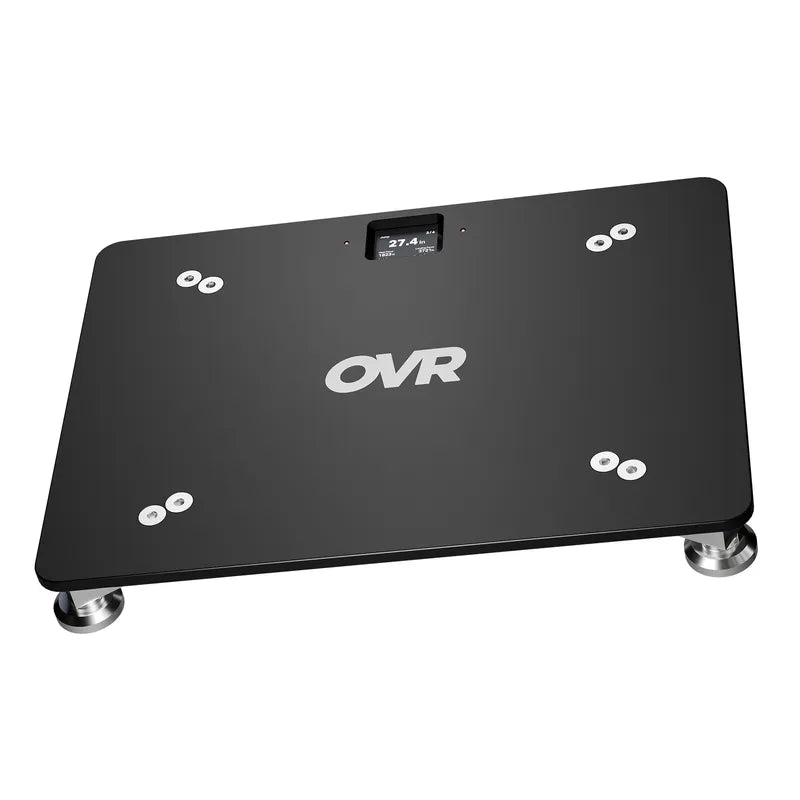
OVR Force computes both and defaults to take-off velocity on a clean bodyweight reading. If the weigh-in is off, a fidget or an early dip, it falls back to flight time and flags it with an "FT" badge, so you always know which produced the height. The point is not which method wins, it is knowing which one produced a number before you line it up against another. Method matters for every force-plate output, not just height, and the same goes for reading an RSI number.
How to use this on test day
Pick one method and one device, and do not switch mid-program. The method gap is larger than many real training changes, so a mid-season switch from one setup to another can manufacture a jump that is not there or bury one that is. Compare the athlete to their own baseline before any table, and when you do use a table, match its method to yours.
Standardize every test: same warm-up, same cue, hands on hips, best of three trials with full recovery between efforts. And do not read height alone. A tired athlete can hold the same height by changing how they jump, a deeper dip or a slower pull, while the underlying output drops, so pair it with the rest of the force-time data and your sprint and strength numbers to build an athletic profile.
Make the number comparable
A jump height becomes useful the moment you can put it next to another number and trust the comparison. Settle on one method, write it down next to your norms, and the table works for you instead of against you. The next time an athlete's number looks low against a benchmark, check the method before you check the athlete.
Sources
- Xu J, et al. Systematic Review of Jump Height Calculation Methods (CMJ/DJ). Sports Med. 2023: https://pmc.ncbi.nlm.nih.gov/articles/PMC10115716/
- Eythorsdottir I, et al. The Battle of the Equations: Systematic Review of Jump Height Calculations Using Force Platforms. Sports Med. 2024: https://pmc.ncbi.nlm.nih.gov/articles/PMC11561012/
- Linthorne NP. Analysis of standing vertical jumps using a force platform. Am J Physics. 2001: https://bura.brunel.ac.uk/bitstream/2438/1392/3/Standing+Vertical+Jump+(Linthorne).pdf
- Moir GL. Three Methods of Calculating Vertical Jump Height from Force Platform Data. Meas Phys Educ Exerc Sci. 2008: https://www.tandfonline.com/doi/full/10.1080/10913670802349766
- Reeve TC, Tyler CJ. Validity of the SmartJump Contact Mat. JSCR. 2013: https://pubmed.ncbi.nlm.nih.gov/23439339/
- Ruf L, et al. Concurrent validity of CMJ and SJ height: contact mat vs force platform in pro soccer. Front Sports Act Living. 2024: https://pmc.ncbi.nlm.nih.gov/articles/PMC11263071/
- Pérez-Castilla A, García-Ramos A. Most Reliable Procedure for Loaded CMJ Height: Take-Off Velocity vs Flight Time. JSCR. 2018: https://pubmed.ncbi.nlm.nih.gov/29570575/
- Wade L, et al. Comparisons of laboratory methods to calculate jump height. Scand J Med Sci Sports. 2020: https://pubmed.ncbi.nlm.nih.gov/31544260/
- Kirby TJ, et al. Relative net vertical impulse determines jumping performance. J Appl Biomech. 2011: https://pubmed.ncbi.nlm.nih.gov/21844609/
- McMahon JJ, Ripley NJ, Comfort P. Force Plate-Derived CMJ Normative Data for Professional Rugby League. Sensors. 2022: https://pmc.ncbi.nlm.nih.gov/articles/PMC9696698/
- McMahon JJ, et al. Understanding the Key Phases of the CMJ Force-Time Curve. Strength Cond J. 2018: https://journals.lww.com/nsca-scj/fulltext/2018/08000/understanding_the_key_phases_of_the.10.aspx
- Hawkin Dynamics. How we Calculate Jump Height from Take-Off Velocity: https://www.hawkindynamics.com/blog/calculate-jump-height-from-take-off-velocity
- Hawkin Dynamics. How we Calculate Jump Height from Flight Time: https://www.hawkindynamics.com/blog/calculate-jump-height-from-flight-time
- Global Performance Insights. How to Calculate Jump Height: Flight Time vs Impulse Momentum: https://www.globalperformanceinsights.com/post/how-to-calculate-jump-height-flight-time-vs-impulse-momentum
- VALD Performance. Understanding the Countermovement Jump: https://valdperformance.com/news/understanding-the-countermovement-jump
- SimpliFaster. Everything You Need to Know About the CMJ on Force Plates: https://simplifaster.com/articles/countermovement-jump-force-plates-guide/
- Science for Sport. Countermovement Jump (CMJ): https://www.scienceforsport.com/countermovement-jump-cmj/
- Suchomel TJ, et al. RSImod reference scale: https://pmc.ncbi.nlm.nih.gov/articles/PMC6315647/
- Attia A, et al. Measurement errors estimating vertical jump height with photocell flight time (Optojump). Biology of Sport. 2017: https://pmc.ncbi.nlm.nih.gov/articles/PMC5377563/


