
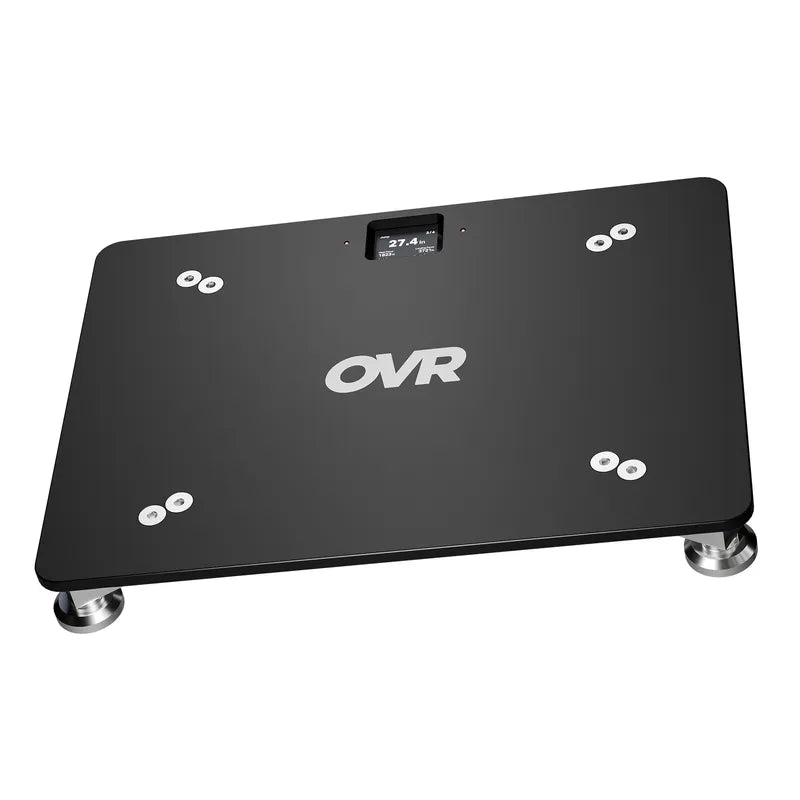
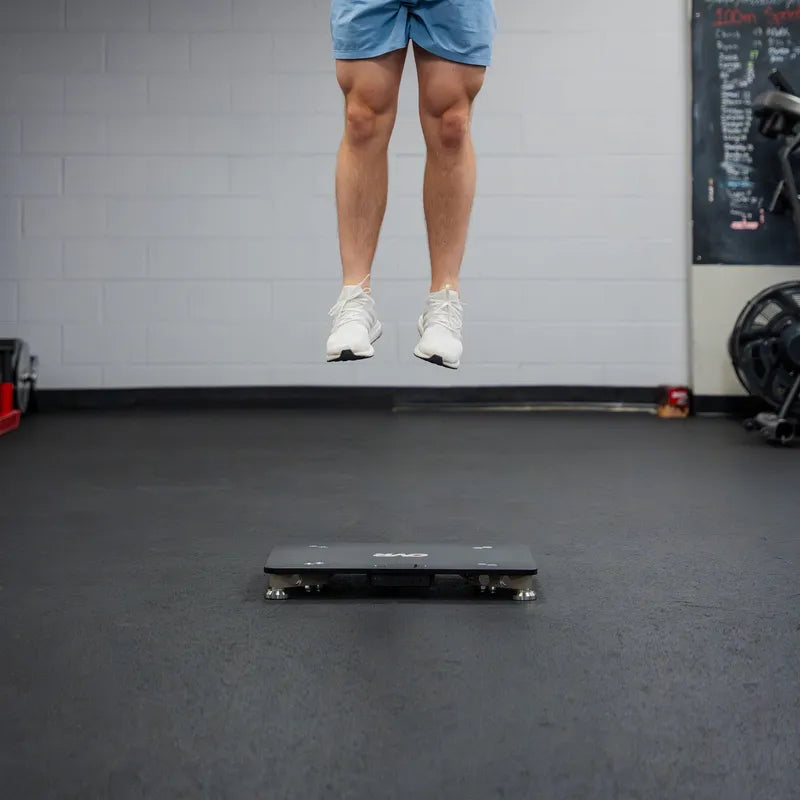


Test the same athlete on two different force plates in the same session and the two jump heights can land three to four inches apart. Same athlete, same effort, same day. That gap is not an error in either plate. It comes down to one decision each device makes quietly: where the jump is counted from. The piece of the movement in between has a name: plantar flexion.
Where a jump height is measured from
Jump height is the rise of the body's center of mass, the single balance point that sits roughly behind the navel. Every device agrees on the top of that rise, the apex of the jump. What they do not agree on is the bottom, the point they call the start.
There are two honest choices. One is the standing position, with the athlete flat on the floor before the jump. The other is the moment the feet actually leave the ground. Those are not the same height, because in the instant before takeoff the athlete is already up on the balls of the feet with the ankles fully extended. The center of mass has climbed a few inches before the feet ever break contact. Measure from standing and that climb counts. Measure from takeoff and it is gone.
What plantar flexion is and why it is the gap
Plantar flexion is the ankle pointing the toes down, the motion that puts you up on the balls of your feet. It is the last thing the legs do on the way up, the final drive through the ankle right before the feet leave the floor. The heels lift, the ankles extend, and the center of mass rises another few inches while the feet are still on the ground.
That rise is the whole difference between the two starting points. The ankle's contribution to a jump is not small; it accounts for roughly a third of the total push, behind the hips and ahead of the knees. A device that starts its measurement from the standing position keeps that contribution in the number. A device that starts at takeoff, when the ankles are already extended, leaves it out.
Ballistic jump height, and what the OVR Force does instead
Most force plates report what is called ballistic jump height, measured from the moment the feet leave the ground. It is a clean read of the airborne phase, but it starts the clock after the ankle drive is already finished, so it does not count the plantar-flexion rise. That is why it reads low.
The OVR Force measures from the standing position instead, so the plantar-flexion phase stays in the number. The result is the rise of the center of mass over the athlete's actual standing height, which is the biomechanical definition of a jump and the same thing a Vertec or a jump-and-reach captures. That is why an OVR Force number lines up with the combine and reach-test figures a coach already carries in their head, while a ballistic plate reads three to four inches under them.
How big the gap is
The plantar-flexion contribution runs about three to four inches (8 to 10 cm) on a normal countermovement jump, and it scales gently with how high the athlete jumps. A taller jumper picks up a little more of it, a shorter jumper a little less, but it stays in that band. This is neutral biomechanics, not a defect in either device.
What to do about it
Pick one device for a given athlete and stay on it. The trend line only means something when the jump is counted from the same starting point every test, and switching between the OVR Force and a ballistic plate mid-block simply adds or removes this plantar flexion value.
When you do need to line an OVR Force number up against a ballistic-plate number, do not read the difference as the athlete getting better or worse. Account for the plantar-flexion gap first, then compare what is left. The athlete may not have changed at all. The starting point did. Keeping the testing consistent rep to rep is what keeps the number meaning the same thing every time.
The number is fine once you know what is in it
Both numbers are honest. A ballistic plate reports exactly what it measures, the rise from takeoff to the top. The OVR Force reports the rise from standing to the top, which keeps the ankle drive in and matches the reach-based standards the sport is built on. Knowing which starting point is on the screen is the difference between a number you can read and a number that surprises you. Expect three to four inches between the two, keep the athlete on one device, and the reading tracks consistently across seasons.
Sources
- Discrepancy Among Different Methods for Vertical Jump Height Determination and Its Implications for Field-Based Testing: A Narrative Review (2022). Measurement in Physical Education and Exercise Science: https://www.tandfonline.com/doi/full/10.1080/1091367X.2022.2163398
- Linthorne, N. P. (2001). Analysis of standing vertical jumps using a force platform. American Journal of Physics: https://bura.brunel.ac.uk/bitstream/2438/1392/3/Standing+Vertical+Jump+(Linthorne).pdf
- Pérez-Castilla, A., et al. (2024). The Battle of the Equations: A Systematic Review of Jump Height Calculations Using Force Platforms. Sports Medicine: https://link.springer.com/article/10.1007/s40279-024-02098-x
- Examining the intrinsic foot muscles' capacity to modulate plantar flexor gearing and ankle joint contributions to propulsion in vertical jumping (2022). Journal of Sport and Health Science: https://www.sciencedirect.com/science/article/pii/S209525462200076X
- Countermovement Jump Performance Is Related to Ankle Flexibility and Knee Extensors Torque in Female Adolescent Volleyball Athletes (2023). PMC: https://pmc.ncbi.nlm.nih.gov/articles/PMC10299299/


