


A force plate is one of the highest-return tools a program or clinic can own, and it is also one of the few where the real price is hidden until you read the contract. Most force plates sold to coaches and clinicians run on a yearly subscription or lease. This force plate buyers guide names every major system, shows what each one costs over time, and lays out the differences that actually change a testing session.
Some pricing is not directly public and is estimated from online sources.
Force plate buyers guide: every system at a glance
| System | Cost | Subscription | On-device display | Sampling | Plate config | Data export |
|---|---|---|---|---|---|---|
| OVR Force | $1,499 single / $2,699 dual, one-time | None | Yes | 1000 Hz | Single or dual | Yes |
| VALD ForceDecks | ~$3,510 to $5,670/yr (3-yr subscription) | Required | No | 1000 Hz | Dual | Not stated |
| Hawkin Dynamics | ~$2,750 to $4,000/yr (lease, by term) | Required | No | 1000 Hz | Dual (wireless) | Included with license |
| Meloq EasyBase | ~$3,500 one-time | None | No | Up to 1600 Hz (400 Hz operating) | Dual | Yes |
| KINVENT | Up to $7k by model | Required | No | 1000 to 4000 Hz by model | Dual (jump models) | Top tier plan only |
| Kistler / AMTI (lab) | Quote-only (~$10k to $25k+/plate, reported) | n/a | No | 1000 Hz+ | In-ground, multi-axis | Lab software |
What actually matters when you choose a force plate
Total cost over three to five years. The upfront price is a fraction of the real cost on most systems. A subscription or lease renews every year while a one-time purchase does not. Before you sign anything, ask two questions: do you own your data, and what is the ongoing fee to retain that data.
Standalone versus tethered. This is the axis almost no buyers guide covers, and it is the one you feel every session. Almost all force plates need a phone, tablet, or laptop connected to test. Having a force plate with a built-in display gives you the option of using the app, and can speed up testing if not required.
Single versus dual. One plate gives you whole-body numbers: jump height, peak force, peak power. Left-right asymmetry needs two independent plates, because you cannot split a single combined signal into left and right. Many force plate systems don't give you the option, and require dual plates. A single and dual plate hybrid system gives you the option, so two plates can be used as two individual stations, or be combined to a single dual plate setup. If you do any rehab or return-to-play work, you likely need two plates.
Sampling rate. 1000 Hz is the safe standard and the rate to ask for. Rate of force development and event-timed metrics like contact time and reactive strength index need roughly 1000 Hz to measure accurately (Maffiuletti et al. 2016). Whole-body countermovement jump peak metrics stay reliable at much lower rates, down to about 200 Hz (Hori et al. 2009), so a plate built only for jump height can get away with less. The point of 1000 Hz is that it covers everything you might test, not just the easy metrics. OVR Force, VALD, and Hawkin all run at 1000 Hz.
OVR Force
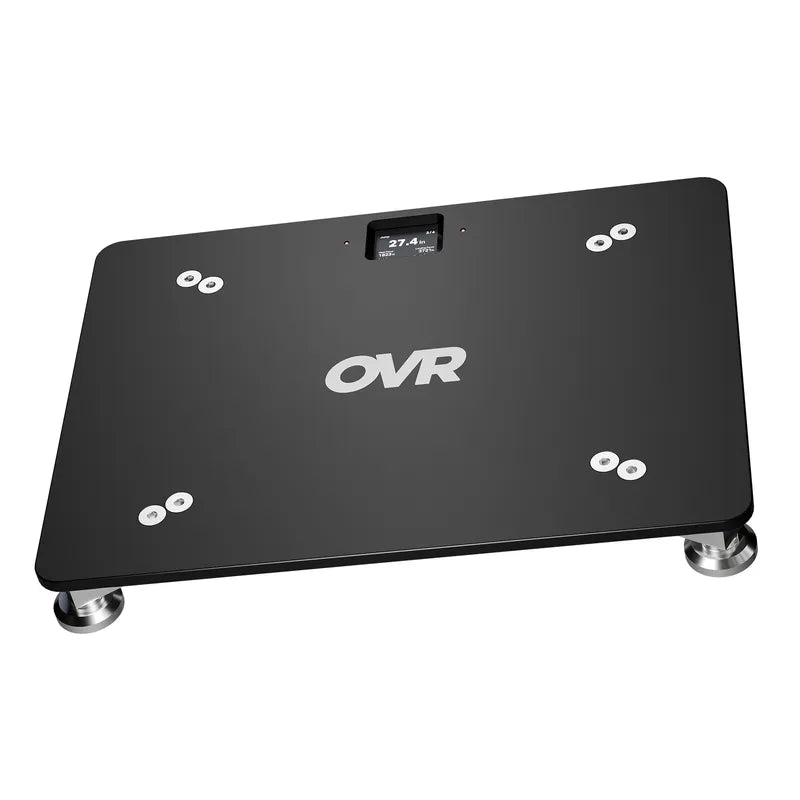
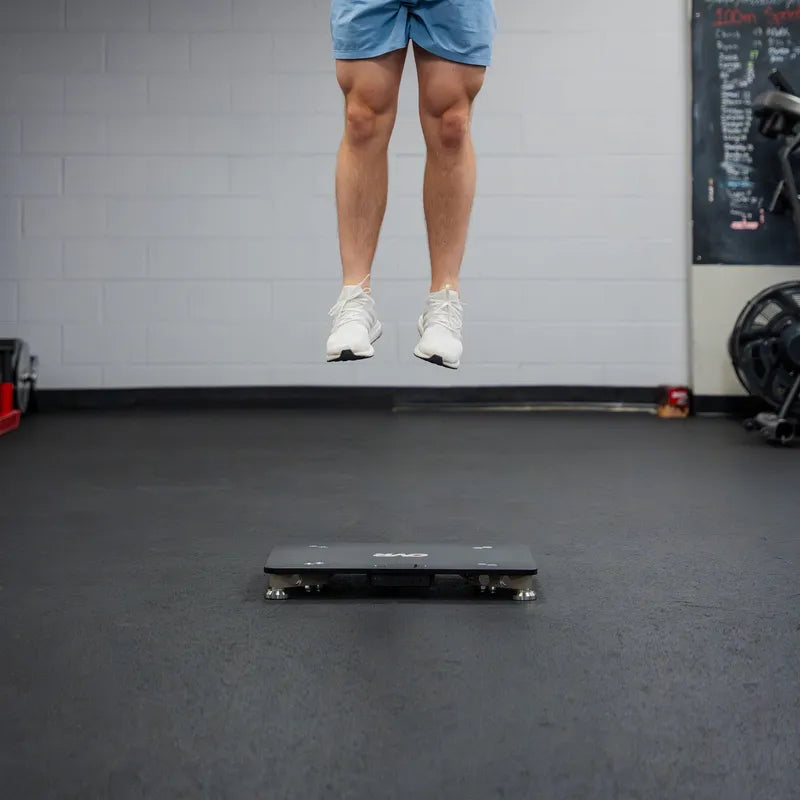
OVR Force is a portable force plate system built to run standalone, paid for once with no subscription behind it.
Specs and details
- Price: $1,499 single, $2,699 dual, one-time. No subscription, free app.
- Display: on-device screen, the only system here with one. Use it with or without the app.
- Sampling and accuracy: 1000 Hz, ±1 N, validated against gold-standard plates.
- Capacity: rated to 4,000 lb (2,000 kg)
- Plate size: 24 x 18 inches (600 x 450 mm)
- Workflow: auto-detects jump type, body weight, start, and rep, with a curated set of 20+ metrics per jump.
- Configuration: one plate for a single station, or two for a dual station or two single stations. Works alongside OVR Jump, Velocity, and Sprint.
Pros
- Lowest multi-year cost here: pay once, own it, no renewal.
- The only on-device display, so it tests without a phone or laptop, which speeds up large-group days.
- Validated 1000 Hz data with auto-detection and a focused metric set.
Cons
- Fewer total metrics shown, with the goal of simplicity
- The plates are large and not the lightest, so a two-plate setup is more to carry than the most compact portable options.
VALD ForceDecks
VALD ForceDecks is a widely used force plate system in sports, with a large normative database and deep validation history.
Specs and details
- Price: reported at roughly $3,510 to $5,670 per year by model, on a three-year all-inclusive subscription that bundles hardware, software, support, and warranty.
- Subscription: required.
- Display: none. Every test runs through a connected iPad or computer.
- Sampling and config: 1000 Hz, dual, uniaxial.
- Workflow: recognizes 20 to 30-plus movements without pre-selecting a test, and weighs the athlete once rather than every rep.
Pros
- Large normative database and deep validation history here.
- A broad movement library with strong automatic test detection.
- The platform many top pro and college programs already standardize on.
Cons
- The highest multi-year cost here, and the subscription renews indefinitely.
- No on-device display, so testing depends on a connected device.
- You do not own the hardware at the end of the term.
Hawkin Dynamics
Hawkin Dynamics is popular across high school and college strength programs, known for wireless dual plates and a coaching-education library.
Specs and details
- Price: listed as a lease, roughly $2,750 to $4,000 per year by term, all-inclusive.
- Subscription: required (lease).
- Display: none. You capture on a mobile app and analyze in a web app.
- Sampling and config: 1000 Hz, dual, wireless.
- Data: clearly documented ownership. You own your data, raw force-time export is supported, and your data stays available for at least 12 months after you stop paying.
Pros
- A clear, strong data-ownership and export policy.
- Wireless dual plates at 1000 Hz with a large coaching-education library.
- Lease pricing published openly.
Cons
- A recurring lease cost, and you do not own the hardware at the end of the term.
- No on-device display.
- The capture workflow includes a quiet-standing weigh-in on each rep.
Meloq EasyBase
Meloq EasyBase is the other pay-once option in this guide, publicly priced with no subscription required.
Specs and details
- Price: publicly listed at around $3,500, one-time. No subscription; tests, reports, and raw data export are included free.
- Display: none. Testing runs through a mobile app.
- Sampling: listed as up to 1600 Hz, with 400 Hz cited as the operating rate in Meloq's own materials.
- Config: dual, wireless.
Pros
- Pay once, no subscription, with reports and raw export included free.
- Publicly listed pricing, which is rare in this category.
- Dual wireless plates.
Cons
- The EasyBase plate's validation studies are described as in progress and are not yet available.
- If 400 Hz is the operating rate, it sits below the roughly 1000 Hz that rate of force development and reactive strength index need, though it is fine for jump peak metrics.
- No on-device display.
KINVENT
KINVENT is a product line rather than a single plate, spanning entry-level plates up to a triaxial research model, and it is strong in physiotherapy with published validation behind it.
Specs and details
- Price: quote-based from KINVENT and varies by dealer, with third parties listing up to roughly $7,000 by model.
- Subscription: required, tiered app plan. Raw data export sits on the top tier.
- Display: none. Wireless and app-driven.
- Sampling: 1000 Hz on the entry plates, up to 2000 Hz on the K-Deltas and 4000 Hz on the larger XL plate (beyond 1000 Hz adds little for the core jump and force tests).
- Validation: K-Deltas validated against a gold-standard lab plate in a peer-reviewed study.
Pros
- Published validation and a strong presence in physiotherapy and rehab.
- A broad model range and a large multi-sensor ecosystem.
- High sampling rates available on the upper models.
Cons
- A required, tiered subscription, with raw export limited to the top tier.
- No on-device display.
- Quote-based pricing that varies by dealer, and entry plates that cannot run jump tests.
Research-grade systems: Kistler and AMTI
Kistler and AMTI are the in-ground lab plates that the portable systems in this guide get validated against. They belong here as context rather than as a head-to-head option.
Specs and details
- Price: quote-only. Third-party reports put research-grade in-ground plates in the range of roughly $10,000 to $25,000-plus per plate, with full lab installs higher.
- Form: fixed or in-ground, flush-mounted into a floor. Multi-axis force in three dimensions.
- Use: biomechanics research and gait analysis.
Pros
- The gold-standard reference that other plates are measured against.
- Multi-axis 3D force that no uniaxial portable plate provides.
Cons
- Far more expensive than any portable system here.
- Fixed or in-ground, so not practical for daily roster testing or moving between stations.
- More capability and complexity than team or clinic testing needs.
What a force plate really costs over five years
The sticker price tells you almost nothing about the five-year cost on most of these systems, because most of them renew every year. Here is the same hardware viewed over a five-year window. The math does the arguing.
| System | Pricing model | 5-year cost | Own it at the end? |
|---|---|---|---|
| OVR Force single | One-time | $1,499 | Yes |
| OVR Force dual | One-time | $2,699 | Yes |
| Meloq EasyBase | One-time | ~$3,500 | Yes |
| Hawkin Dynamics (5-yr lease) | Lease, ~$2,750/yr | ~$13,750 | No |
| VALD FDLite | Subscription, ~$4,230/yr | ~$21,150 | No |
| VALD FDMax | Subscription, ~$5,670/yr | ~$28,350 | No |
| KINVENT | Hardware (~$3k to $7k) + yearly app subscription | Hardware plus five years of subscription | Hardware yes, software access no |
The pay-once systems are OVR Force and Meloq EasyBase. Everything else carries a recurring cost that does not stop, and on the lease and subscription systems you do not own the hardware at the end of the term.
Which force plate is right for you
The right force plate depends on what you test, how many athletes you run through it, and how your budget is structured.
High school programs. Budget is usually the binding constraint, and a one-time purchase is far easier to get approved than a recurring line item that comes back every year. OVR Force at $1,499 single or $2,699 dual, with a free app and no renewal, fits how most high school budgets actually work. Meloq EasyBase is the other pay-once option to look at.
College and pro programs. If you need a large normative database, the broad movement library, and the platform many major leagues already standardize on, VALD ForceDecks could be a good fit, and a program that uses all of that depth can justify the cost. If you want validated 1000 Hz dual-plate data without an ongoing subscription, and you are building a multi-tool athlete profile across jump, sprint, and strength, OVR Force covers the core testing at a fraction of the multi-year cost (as just a one time cost).
Private training facilities. Throughput and uptime matter most, and a standalone plate that any coach can use without pairing a device keeps a busy floor moving. OVR Force tests without a phone or laptop, which removes the per-athlete setup steps a tethered system adds.
PT and rehab clinics. You need two plates for asymmetry and return-to-play work, and you need export you actually own. KINVENT could be worth a look for its physiotherapy validation if a tiered subscription fits your model, and Hawkin's documented data ownership is a plus. OVR Force gives you dual-plate asymmetry, validated accuracy, and data with no tier, paid once.
Where the value lands
For most coaches and clinics buying their first or next force plate, the decision comes down to two numbers: what the system costs to keep over five years, and how many steps it adds to every athlete on testing day. OVR Force answers both. It is validated 1000 Hz dual-capable data with an on-device display that tests standalone, your data stays yours, and you pay once at $1,499 single or $2,699 dual with no subscription behind it. If what you want is accurate force data you own outright, without a renewal that never ends, start with OVR Force.
Sources
- Maffiuletti et al. 2016, European Journal of Applied Physiology: https://link.springer.com/article/10.1007/s00421-016-3346-6
- Hori et al. 2009, Journal of Strength and Conditioning Research: https://pubmed.ncbi.nlm.nih.gov/19387390/
- Badby et al. 2023, Sensors: https://pmc.ncbi.nlm.nih.gov/articles/PMC10224001/
- Mao et al. 2024, Sensors: https://pmc.ncbi.nlm.nih.gov/articles/PMC11397850/
- SimpliFaster, A Practical Guide for Using Force Plates in Elite Sports: https://simplifaster.com/articles/force-plates-practical-guide/
- Sportsmith (McMahon), A guide to using force plates in sports performance: https://www.sportsmith.co/articles/guide-to-using-force-plates-in-sports-performance/
- VALD ForceDecks pricing model: https://valdperformance.com/news/vald-pricing-model
- Hawkin Dynamics pricing (product page): https://www.hawkindynamics.com/product-page
- Hawkin Dynamics, data ownership in sports technology: https://www.hawkindynamics.com/blog/data-ownership-in-sports-technology
- Meloq EasyBase force plates: https://meloqdevices.com/products/forceplates-easybase
- KINVENT K-Deltas validation, IJSPT: https://ijspt.scholasticahq.com/article/89261-validation-of-a-portable-wireless-force-platform-system-to-measure-ground-reaction-forces-during-various-tasks


