


A countermovement jump number only means something if every rep across your roster is collected the same way. The whole skill of running a CMJ test is building a field protocol that holds steady from one session to the next, so a drop of just under an inch is a real signal and not a footnote about how you ran the test that day. Force plate testing gives you the resolution to catch that drop, but resolution is wasted if the conditions underneath it keep shifting. For a coach moving multiple athletes through a session, the variable you actually control is the protocol.
This is not a lab procedure. It is a routine that works for a full team and stays comparable across a season.
Set the conditions before anyone jumps
Standardize everything that is not the athlete's effort. Same time of day, same warmup, same footwear, same surface, same cues in the same words and tone. These sound minor until you remember you are comparing a number to itself across weeks, and any of them can move a CMJ enough to look like a training effect when it is just a different setup.
The quiet-standing weighing phase is the one most coaches skip past, and it corrupts more data than anything else. Before the jump, the athlete stands still for at least a second so the plate can establish body weight. That weight is the reference the plate uses to calculate net impulse, and net impulse is what drives jump height, power, and every impulse-derived metric. If the athlete sways, shuffles, or shifts during weighing, the bodyweight reading is wrong, and so is everything downstream.
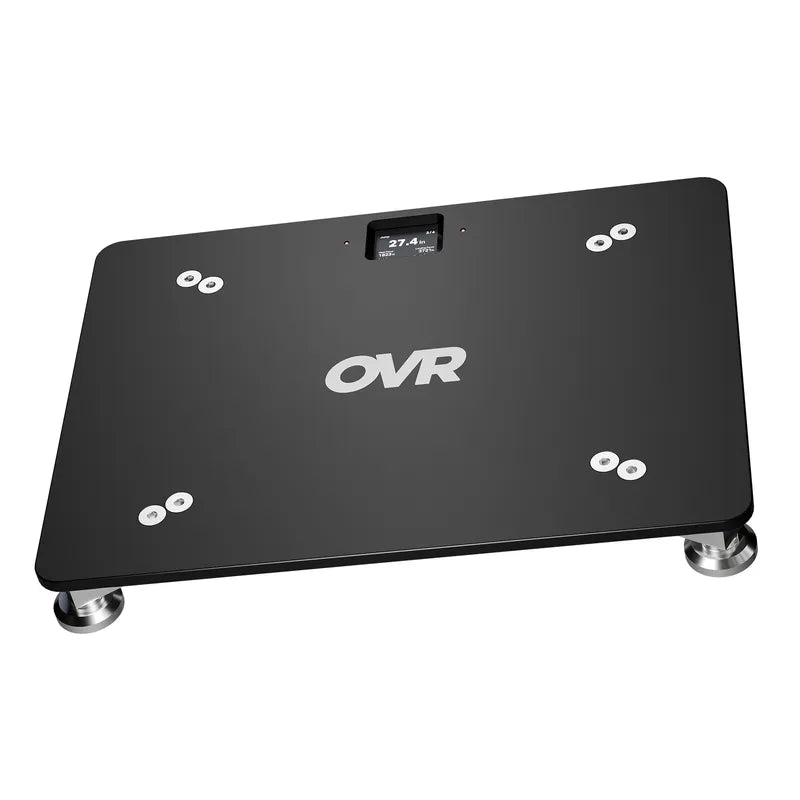
An enforced sequence removes the guesswork. The OVR Force runs a badge flow that gates the rep: STEP ON shows red, then HOLD turns yellow while the plate detects bodyweight, then JUMP turns green only once the athlete has held still long enough. The athlete cannot jump on a bad weighing phase, because the plate will not give the green light until the standing is clean.
Run the rep the same way, every time
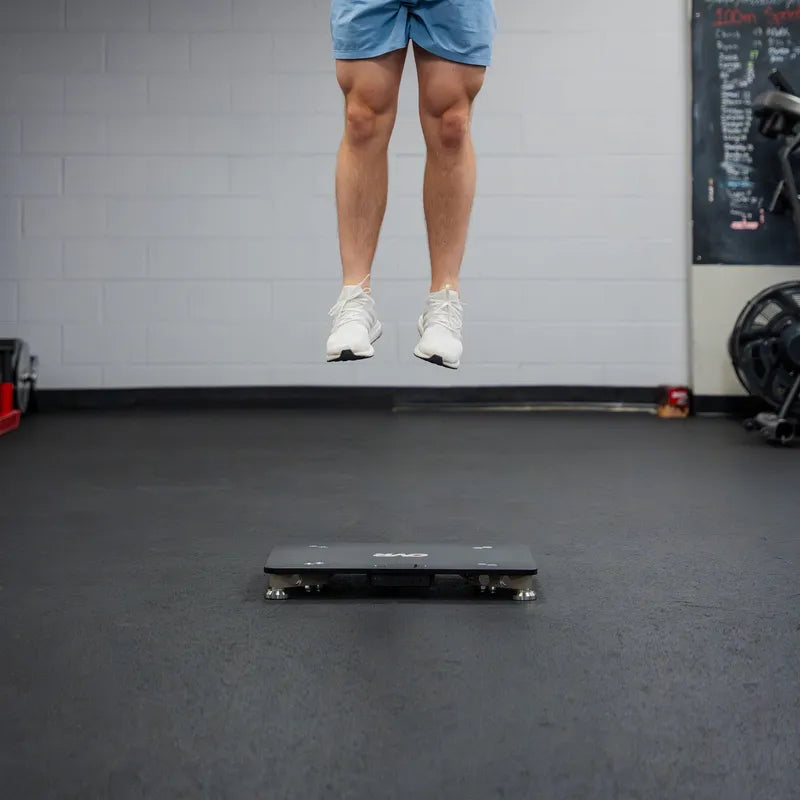
The rep itself is short. The athlete stands still and gets weighed, keeps hands on hips, dips fast and jumps as high as possible, keeps the legs straight in the air, and lands back on the plate. Run three valid reps with around 30 seconds of rest between them. The broader literature uses anywhere from 10 to 60 seconds, so pick one and hold it. Lean toward 45 to 60 seconds when you are running more reps or testing a fatigued athlete for readiness, where too short a rest depresses the later reps and reads as fatigue that is really just incomplete recovery. Each rep should land within about 5 percent of the mean of the three; if one is way off it was a mistrial, so toss it and take another. For a periodic max benchmark, the best of three is a fair ceiling. For the readiness trend you watch week to week, log the mean of the valid reps, because the average is more sensitive to fatigue than a single best jump.
Hands on hips is the call most testing protocols get wrong, and for a team it is not close. Arm swing adds roughly 10 to 20 percent to jump height, more in younger or less coordinated jumpers, and the size of that boost varies athlete to athlete based on coordination and limb length. You cannot standardize it across 40 kids. One athlete generates a big swing, the next barely uses the arms, and now you are comparing two different movements and calling them the same test. For a number you compare across a mixed roster, lock the arms on the hips, since arm swing is the part you cannot standardize from one athlete to the next. Arm swing is still a legitimate test in its own right, and you can track it across a season. The rule is not that arm swing is banned, it is that you pick one condition, standardize it, and never blend arm-swing and hands-on-hips jumps in the same trend.
Give one cue and give the same cue every time: "Hands on hips. On JUMP, dip fast and jump as high as you can. Land on the plate." External cues like jumping toward the ceiling beat internal cues like extending the hips hard. The words, the tone, and the volume are part of the protocol, so do not improvise them on rep 200 because you are tired.
Pick the jump-height number you trust
If that number came from a jump mat or an old hand-measured method, it was likely a flight-time or reach-based figure with arm swing, and it can read different than a clean, arms-on-hips, impulse-momentum number. Keep the same gap in mind whenever you eyeball general vertical jump benchmarks: those standing-jump tables are a different measurement than a force-plate CMJ. The athlete did not lose anything, the methods are just different. Pick one method and stay on it so every athlete is measured against the same definition. The OVR Force defaults to the velocity-based impulse-momentum number and puts an "FT" badge on the display whenever it falls back to flight time, so you always know which method produced the height in front of you.
The mistakes that quietly corrupt a season of data
Most bad CMJ data does not come from one obvious failure. It comes from small drifts nobody flags in the moment. Here is the checklist to run against every rep:
- Swaying or jumping early during the weighing phase, which throws off bodyweight and every impulse-derived metric.
- Arm swing creeping back in, which breaks the comparison to earlier sessions.
- Changing the dip depth rep to rep, which moves the time to takeoff and with it mRSI (modified reactive strength index, jump height divided by time to takeoff).
- Pausing at the bottom of the dip, which turns it into something closer to a squat jump.
- Chasing a single best number for monitoring instead of the mean of valid trials.
- Watching only jump height while the strategy underneath degrades.
The last two are the ones experienced coaches still fall into. A single best jump hides fatigue that a mean of trials would expose. And height alone is a blunt readout. The athlete can hold a jump number while the way they produced it falls apart, which is why mRSI sits next to height on many CMJ dashboards: it reads the explosiveness behind the jump, not just the result. It is one of a handful of force plate metrics that matter most once you look past height.
Read the trend, not the number
A CMJ number means the most when you track it against the athlete's own baseline over time. That trend is what tells you whether training is working and whether an athlete is fresh or fading. Population norms still have a place: they give you context for where an athlete sits and a realistic target to develop toward. The rule is to compare like with like. A table built from a flight-time, arm-swing protocol will not always line up with a clean, arms-on-hips, impulse-momentum number, so use a reference that matches how you test and read it as context, not a pass-or-fail grade.
Build the baseline first, then watch how it moves. In a clean, controlled setup, a healthy athlete's jump height drifts about 5 percent or less from day to day. On a field roster, where you cannot lock every condition the way a lab can, expect closer to 5 to 9 percent. That is the normal day-to-day bounce, not the rep-to-rep agreement you checked inside the set. It is noise, not fatigue, and reacting to it will have you chasing ghosts. A meaningful drop is one larger than the athlete's own typical variation, and telling that signal from the daily bounce is why you monitor readiness with weekly testing.
Jump height is also a lagging indicator. By the time height falls, fatigue has usually been present for a while. The strategy metrics move first: mRSI drops while height holds, time to takeoff lengthens, and braking force or impulse falls off. Watching those gives you an earlier read on neuromuscular state than height alone.
Test fresh to get a clean read. Run the CMJ early in the session, after a standardized warmup and before any fatiguing work, so a drop reflects how the athlete showed up rather than the lifting they just did. Two cadences cover most programs: benchmark every 4 to 8 weeks to track adaptation, and monitor readiness on a fixed weekly point and is helpful in managing in-season fatigue. Testing the same fixed protocol two to three times a week builds a usable trend inside four to six weeks.
Write down your protocol, post it where you test, and run it the same way every session for the rest of the season. A clean CMJ trend is also just one test, and combined with jump, sprint, and strength data you have a fuller picture of an athlete's performance profile. A CMJ number is only as good as the routine that produced it, so build the routine first and let the data come to you clean.
Sources
- McMahon et al. 2018, NSCA S&C Journal 40(4):96-106: https://journals.lww.com/nsca-scj/fulltext/2018/08000/understanding_the_key_phases_of_the.10.aspx
- Sole/Suchomel/Stone et al. 2018, Sports 6(4):133 (RSImod D-I scale): https://pmc.ncbi.nlm.nih.gov/articles/PMC6315647/
- MDPI Sensors 2024, 24(17):5748 (dual-force-plate validity): https://www.mdpi.com/1424-8220/24/17/5748
- Frontiers in Sports and Active Living 2024 (CMJ contact mat vs force platform): https://www.frontiersin.org/journals/sports-and-active-living/articles/10.3389/fspor.2024.1437230/full
- German Journal of Exercise and Sport Research / Springer (FT overestimation): https://link.springer.com/article/10.1007/s12662-026-01096-7
- PeerJ 2024 (ankle-position flight-time error simulation): https://peerj.com/articles/17704/
- Applied Sciences 2020, 10(3):776 (landing posture & FT height): https://www.mdpi.com/2076-3417/10/3/776
- Reliability of Vertical Jump Force-Time Metrics in Collegiate Athletes (PMC): https://www.ncbi.nlm.nih.gov/pmc/articles/PMC12733763/
- Inter-Day Reliability of CMJ Metrics in Elite Academy Soccer Players (IUSCA): https://journal.iusca.org/index.php/Journal/article/view/504
- Frontiers in Physiology 2019 (CMJ/SJ testing methods review): https://pmc.ncbi.nlm.nih.gov/articles/PMC6853898/
- European Journal of Sport Science / Wiley (countermovement depth & RSImod): https://onlinelibrary.wiley.com/doi/10.1080/17461391.2020.1845815
- Science for Sport, Countermovement Jump (CMJ): https://www.scienceforsport.com/countermovement-jump-cmj/
- SimpliFaster, Everything You Need to Know About the CMJ on Force Plates: https://simplifaster.com/articles/countermovement-jump-force-plates-guide/
- SimpliFaster, Force Plates in Practice: What I Learned in My First Year: https://simplifaster.com/articles/force-plates-in-practice-what-i-learned-in-my-first-year/
- Driveline Baseball, What Is the Countermovement Jump (CMJ) Test?: https://www.drivelinebaseball.com/2020/11/what-is-the-counter-movement-jump-cmj-test/
- MDPI Biomechanics 2025 (arm swing contribution to CMJ): https://www.mdpi.com/2673-7078/5/3/45
- Gathercole et al. 2015, IJSPP 10(1):84-92 (alternative CMJ analysis / fatigue): https://journals.humankinetics.com/view/journals/ijspp/10/1/article-p84.xml


