
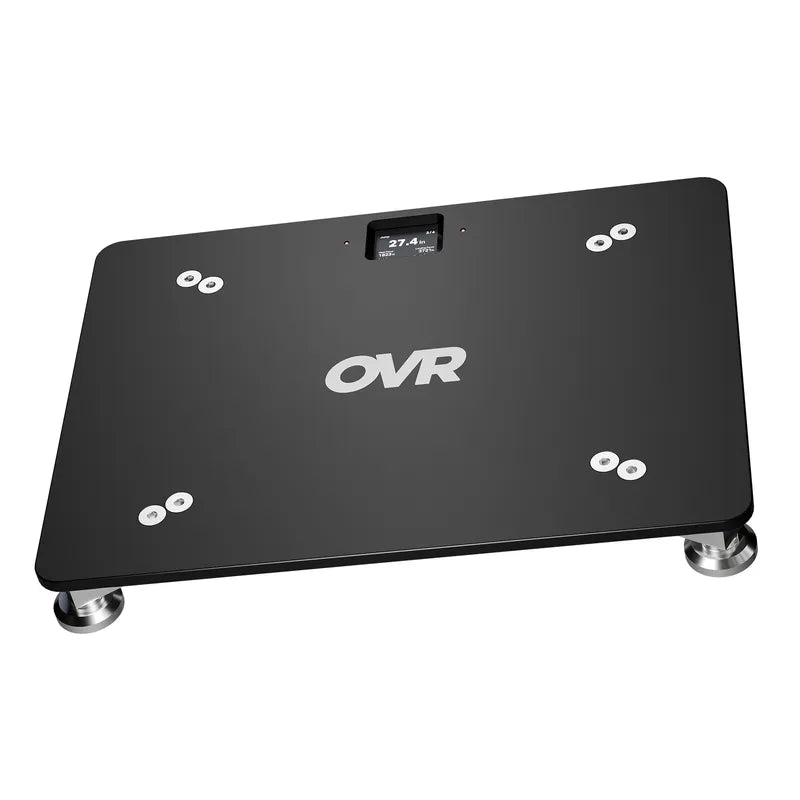



You have an athlete who jumps fine and lifts fine, and one off-season to make them better. The Dynamic Strength Index settles which quality to push first: the ratio of ballistic force to maximal force, separating athletes who need more strength from those who have it but can't express it. It reads off the same force plates you already use for jump testing, and the principles of off-season training go further once you know which way to push. Read it against the athlete's own history, since the ratio shifts with how it was measured.
What DSI Is
DSI = CMJ Peak Propulsive Force ÷ IMTP Peak Force (gross): peak push-off force in a countermovement jump over peak force in a maximal isometric mid-thigh pull. Both are gross, body weight included. Net force subtracts body weight, a different fraction of each peak, so a net or scaled ratio stops matching the published bands. This is the Sheppard, Chapman and Taylor (2011) formulation those bands came from.
A low ratio means little of the athlete's max force shows up in the jump, with strength in reserve. A high ratio means jump force is near their isometric max, so the ceiling caps them.
Run It in Order
Jumps first, pull second, and run both fresh before any heavy lifting. Testing the explosive jump ahead of the maximal pull is the standard order and keeps the numerator from reflecting a prior max effort.
CMJ:
- Hands on hips, no arm swing. Same recorded shoulder-width stance each session.
- Cue a fast dip into a max jump, one motion, no pause at the bottom.
- Three valid reps, 30 to 90 seconds apart, keep the best. Void a rep if the hands leave the hips, the athlete pauses, or lands off the plate.
IMTP:
- Start with the bar fixed at mid-thigh, the point on the thigh midway between the hip and the kneecap, with the athlete standing tall and upright. Knee around 130 degrees, hip around 145. Straps on. Record the bar height, because an inch of drift moves the number.
- Warm-up pulls at 50% and 75%, then three maximal reps of about three to five seconds, two to three minutes apart, keep the best. Cue them to push the floor away, hard and fast, until you call stop.
Read the Zones
Jump peak ÷ pull peak. A 2,400 N jump and a 3,000 N pull is 0.80.
- Below 0.60: Strength-surplus, can't express enough of the strength they have. Bias ballistic and plyometric training and dynamic-effort work.
- 0.60 to 0.80: Balanced. Train both.
- Above 0.80: Strength-limited, the ceiling caps the jump. Bias maximal strength.
The mechanism is documented: in a strength-training study, a high-DSI group dropped from 0.85 to 0.74, while a low-DSI group held at 0.56 because strength was not their need.
Check Strength First
DSI is a ratio, so a low number on its own does not tell you whether the strength underneath is real. Two athletes can both sit at 0.55 and need opposite work. The first has a big pull and a smaller jump: real strength in reserve that is not showing up fast, so you train the expression with ballistic and plyometric work. The second is simply weak, a low pull and a low jump that happen to divide to the same ratio, and there the answer is to build strength first, because there is not enough force to express yet. Prescribe plyometrics to that second athlete off the ratio alone and you train the wrong quality.
What tells them apart is IMTP relative peak force, the pull divided by body weight, or how strong the athlete is for their size. Read it next to the ratio: a low DSI with strong relative force is true strength-surplus, while a low DSI with weak relative force means strength comes first. That pairing is the power versus strength call the whole test exists to make.
So a 250-pound lineman with a strong pull for his size and a low ratio is the strength-surplus case: train him to express it. A 160-pound explosive guard usually runs high DSI and is strength-limited, so the ceiling caps the jump and you build the strength.
Your 0.72 Isn't Their 0.72
Run DSI one way and keep it there: a bilateral countermovement jump over an isometric mid-thigh pull, gross on both sides, the same setup every retest. Measured any other way the number shifts, so your DSI is not comparable to one from another system or protocol, and dip depth alone moves the jump peak. Track it against the athlete's own baseline, not an outside figure, and read it as one filter inside a full athletic profile, not a standalone grade.
A flat DSI is not a failed block. If both peaks rise together the ratio holds while the athlete improved, so log the raw CMJ and IMTP peaks beside it. The same pair shows whether an injury deficit is missing strength or its expression. A DSI is not a return-to-play clearance gate on its own.
Run It Clean, Every Block
Budget 10 to 15 minutes per athlete, and recompute between blocks rather than weekly. A single day's number is noise; the signal is which way an athlete's own DSI moves over time. DSI used to mean a five-figure lab. Now it comes off the same plates running your jump and pull testing. Run the tests in order, calculate gross over gross, keep the protocol consistent, and read against the athlete's history and relative strength. It gives a needs analysis a clear answer: build the strength base, or build the expression on top.
Sources
- Sheppard, Chapman & Taylor (2011), An Evaluation of a Strength Qualities Assessment Method for the Lower Body, Journal of Australian Strength and Conditioning 19:14-20: https://www.researchgate.net/publication/270904788_An_Evaluation_of_a_Strength_Qualities_Assessment_Method_for_the_Lower_Body
- Comfort et al. (2018), Changes in Dynamic Strength Index in Response to Strength Training: https://pmc.ncbi.nlm.nih.gov/articles/PMC6315417/
- Comfort, Thomas et al. (2018), Comparison of Methods of Calculating Dynamic Strength Index, IJSPP 13(3):320-325: https://journals.humankinetics.com/view/journals/ijspp/13/3/article-p320.xml
- Thomas, Dos'Santos & Jones (2017), A Comparison of Dynamic Strength Index between Team-Sport Athletes, Sports (MDPI): https://pmc.ncbi.nlm.nih.gov/articles/PMC5968972/
- Comfort & Dos'Santos (2025), Comparisons Between Different Methods of Calculating the Dynamic Strength Index: Effect on Training Recommendations, PLOS One: https://journals.plos.org/plosone/article?id=10.1371/journal.pone.0331519
- Bishop et al. (2024), The Dynamic Strength Index: Is This a Useful Tool When Programming?, UKSCA Journal 71: https://cdn.uksca.org.uk/cms-uploads/assets/uksca_journal_71_summer_24_Bishop_et_al_DSI_1b042a4a5b.pdf
- Science for Sport, Dynamic Strength Index: https://www.scienceforsport.com/dynamic-strength-index/
- Science for Sport, Isometric Mid-Thigh Pull: https://www.scienceforsport.com/isometric-mid-thigh-pull-imtp/
- GymAware, Practical Uses for the Dynamic Strength Index: https://gymaware.com/practical-uses-for-the-dynamic-strength-index/
- IUSCA Journal, Relationship Between Components of the Dynamic Strength Index: https://journal.iusca.org/index.php/Journal/article/download/199/254
- Maffiuletti et al. (2016), Rate of Force Development: Physiological and Methodological Considerations, European Journal of Applied Physiology: https://pubmed.ncbi.nlm.nih.gov/26941023/
- Meloq Devices, Isometric Mid-Thigh Pull: The Complete Guide: https://meloqdevices.com/blogs/meloq-updates/mid-thigh-pull


