


Force plates are the most direct way to measure how an athlete produces force. They have also been some of the most expensive equipment in the building. A pro-level setup runs north of ten thousand dollars for the hardware, and most of them charge an annual subscription on top of that before you can access your own data. That cost is the reason force plates have lived in professional teams and well-funded college programs and almost nowhere else.
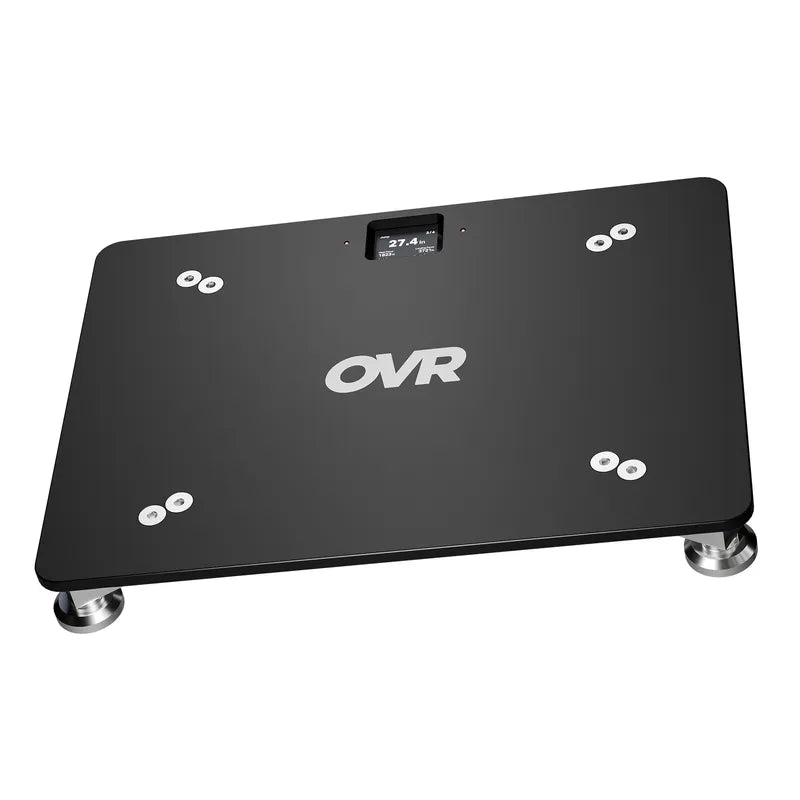
OVR Force reconfigures that situation. It is a standalone force plate that starts at $1,499, runs on no subscription, and shows results on a screen built into the plate itself.
The measurements are the same as gold standard systems. Countermovement jump, isometric mid-thigh pull, drop jump, reactive strength, asymmetry, to name a few. What we removed is the lofty price, the recurring fee, and the lab setup associated with them.
Why force plates stay out of weight rooms
Force plate testing has been validated and trusted in sport science for decades [1][2]. OVR Force does not reinvent any of that. What kept the data out of most weight rooms was the cost of getting to it.
A single OVR Force plate is $1,499. The dual-plate bundle is $2,699, which saves $299 over buying two singles. There is no subscription, and the OVR Connect app is free for as long as you own the plate. You buy it once, with no recurring fees to access your data.
What changes at that price is who gets access. The data that used to be reserved for the largest programs is now within reach of those without the biggest budget.
Step on, get your number
The screen is the part coaches notice first. Every other force plate on the market sends its data to a tablet or a laptop, which means you test through a piece of software on a second device. OVR Force shows the result on the plate the moment the rep ends. One large number up top, four more in a grid below it, no phone required.
The plate walks the athlete through the rep on its own. A color badge tells them exactly where they are: red to step on, yellow while their weight settles, green when it is ready, and blue once the rep starts. Bodyweight is detected automatically.
Coach View flips the display 180 degrees so it faces you instead of the athlete. Both of you read the same number without anyone leaning over the plate. The plate is built to work the way a coach already works: step on, get the number, move to the next athlete. Putting the result in front of the athlete the second they land is also part of how visible data changes how athletes train.
One plate or two
Most force plate companies only sell plates in pairs, bilateral testing being the selling point. OVR Force sells a single plate on its own. A coach who wants countermovement jump, jump height, reactive strength, and isometric pull numbers can get all of that from one plate at $1,499 and decide later whether left-to-right data is worth a second one. For a program weighing how many devices it actually needs, starting with one becomes a real option.
A single plate runs all three modes. The second plate adds one thing: left-to-right asymmetry. Two plates join with the included cable, and the system reports the imbalance with direction and size. That bilateral data is the reason physical therapy clinics and return-to-play settings reach for two plates [7][8]. If asymmetry is not what you are testing for, one plate covers the rest.
3 Modes
OVR Force runs three modes, and the mode matches the test.
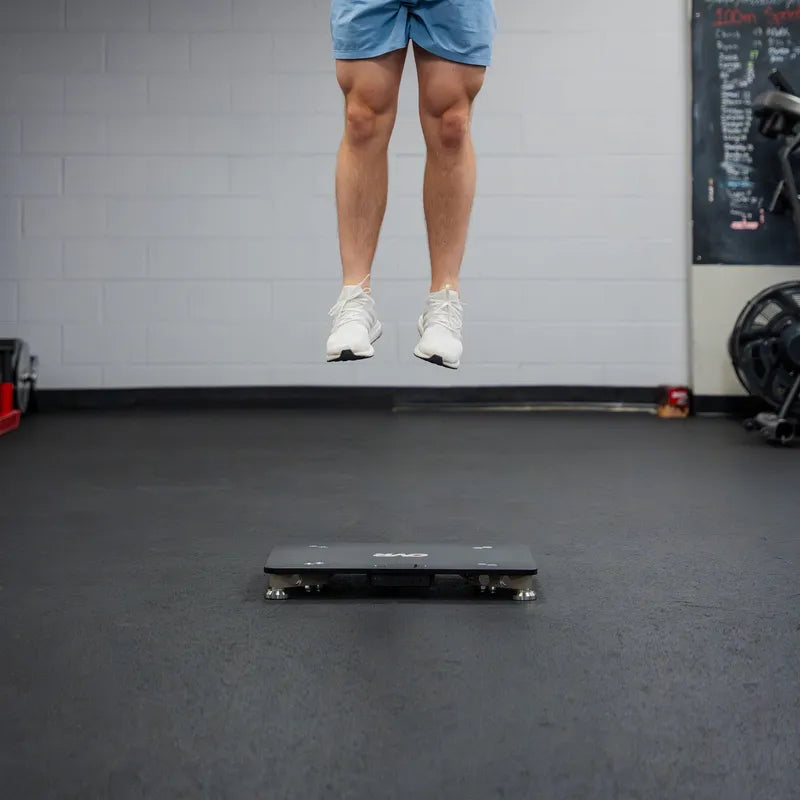
Jump Mode handles countermovement jumps, squat jumps, drop jumps, or any other jump. It detects the jump type on its own and reports jump height, power, reactive strength index, and a phase-by-phase breakdown of each jump. Jump height uses the impulse-momentum method first and falls back to flight time when it has to, with a badge on screen so you can tell which method ran [3][4].
Force Mode handles standing isometric tests like the isometric mid-thigh pull, where peak force and how it scales to bodyweight are the numbers that matter [5][6].
Free Mode covers the isometric work done off the plate, when the athlete is not standing on it.
Built to the same standard
OVR Force costs a fraction of a pro-level system and measures to the same standard.
It samples at 1,000 Hz, the same rate the pro-level plates use. That speed captures how quickly an athlete builds force at the start of a rep, known as rate of force development [9]. Accuracy is plus or minus 1 N. The plate is rated to 4,000 pounds, and was validated it directly against the top pro-level force plates on the market.
The top is half-inch hard anodized aluminum. A single plate weighs about 32 pounds and runs up to 18 hours on a charge. It is a $1,499 instrument that reads like its $10,000+.
Where it fits in your testing
A force plate is one instrument in a testing system, not the whole thing. Jump testing, sprint timing, and bar velocity each measure a different quality, and the clearest read on an athlete comes from jump, sprint, and strength data used together. OVR Force shares the free OVR Connect app with the rest of the OVR lineup, so the force numbers land in the same place as everything else you already track.
The plate works on its own without the app. When you do connect it, the app adds live data, syncs every rep, and pushes firmware updates.
If your program has wanted force plate data and could never justify the price, that data is finally within reach.
Sources
- A Practical Guide for Using Force Plates in Elite Sports, SimpliFaster: https://simplifaster.com/articles/force-plates-practical-guide/
- Countermovement Jump (CMJ), Science for Sport: https://www.scienceforsport.com/countermovement-jump-cmj/
- The Battle of the Equations: A Systematic Review of Jump Height Calculations Using Force Platforms: https://pmc.ncbi.nlm.nih.gov/articles/PMC11561012/
- Using Portable Force Plates to Assess Vertical Jump Performance: A Metrological Appraisal: https://pmc.ncbi.nlm.nih.gov/articles/PMC6316494/
- Intra-Trial Reliability and Usefulness of Isometric Mid-Thigh Pull Testing on Portable Force Plates: https://pmc.ncbi.nlm.nih.gov/articles/PMC7052723/
- Isometric Mid-Thigh Pull (IMTP), Science for Sport: https://www.scienceforsport.com/isometric-mid-thigh-pull-imtp/
- Does the 10% Asymmetry Threshold Matter? Effects of Lower-Limb Asymmetries on Jumping and Agility in Basketball: https://pmc.ncbi.nlm.nih.gov/articles/PMC12641735/
- Investigation of Force Plate Jump Testing Metrics Relevant to Return to Play Decision Making in Basketball Athletes After Anterior Cruciate Ligament Reconstruction: https://pmc.ncbi.nlm.nih.gov/articles/PMC12222032/
- Standardization and Methodological Considerations for the Isometric Mid-Thigh Pull (Comfort et al., 2019, NSCA Strength and Conditioning Journal): https://journals.lww.com/nsca-scj/fulltext/2019/04000/standardization_and_methodological_considerations.10.aspx


