


A force plate's real payoff is not any single test. It is the line those tests draw across a season. A weekly number tells you whether an athlete is tired today. A season of numbers tells you something bigger: whether the plan is working. Did the training you banked in the early months actually carry into the season, or did it quietly slip away once the games piled up? Is each athlete trending up, holding steady, or sliding without anyone noticing until it is too late to fix? That is the read a season of data gives you, and this is how to set it up and act on it, even when you are the only staff the program has.
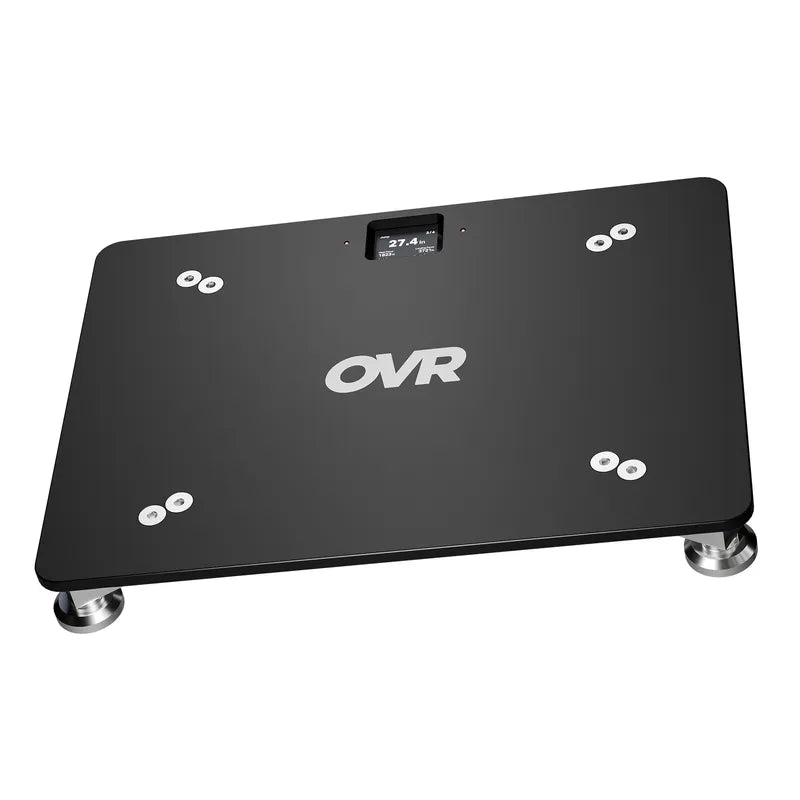
That kind of tracking used to be a pro and Division I privilege, locked behind multi-plate systems, a sports scientist to read the data, and a subscription that renewed every year whether the team used it or not. A single standalone force plate, with no recurring fee and no analyst on staff, draws the same line. The capability is no longer about budget. It is about reading your own season.
Start With a Baseline
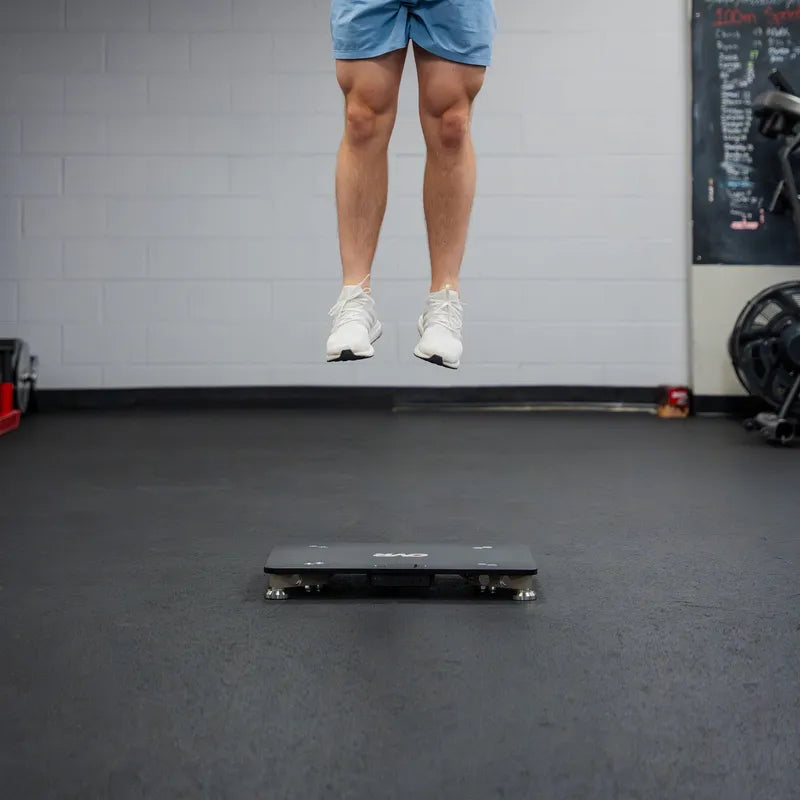
The baseline is the reference every later test reads against, so set it at the start of off-season while athletes are healthy and rested. Have each athlete do three to six countermovement jumps (CMJ), then track the average rather than the single best rep, since the average moves more cleanly with fatigue and recovery. Lock the conditions and keep them locked all season: same time of day, warm-up, footwear, cueing, rest between trials, and the same plate placement on the same surface. Change any of those and you measure the setup, not the athlete.
This is also where the off-season block itself begins, and the same off-season training principles that shape the training tell you what to expect the numbers to do. Baseline max strength in this same window too, so both numbers start from the same rested reference.
Pick the Numbers You'll Follow All Year
You do not need most of what a force plate reports. For a full season, jump height is the workhorse: reliable, easy to explain, and it tracks general lower-body readiness. Add one strategy number that describes how the jump was produced, not just how high it went, like time-to-takeoff or modified reactive strength index (mRSI), which is jump height divided by time to takeoff. That second number catches the tired athlete who holds their height by grinding out a slower jump, since the same height over a longer takeoff drops the ratio.
Track strength too, just less often. Max strength changes slowly, so an isometric mid-thigh pull (IMTP) every few weeks is plenty, with peak force as the number to dial in on. Where the jump tells you what an athlete can produce today, the IMTP tracks whether the strength behind it is still building.
Read Each Phase Against Its Job
A season is not one long block, and the numbers should not be read like one. Read each number against what the training is emphasizing right now: the question is always whether the number tied to the current emphasis is moving the way the work intends. That holds however you periodize. If you build in long linear blocks, read against the block. If you rotate qualities week to week, read against the block's center of gravity over several weeks rather than whatever you trained yesterday, and test at the same point in the microcycle so a post-heavy-day jump is not mistaken for a trend.
In off-season, the emphasis is building, so the strength number is the one that should trend up across the block. Jump height is read differently here. Under heavy accumulation it often holds or dips modestly, and that dip is normal: it is fatigue from the work, not lost power, especially since you keep some fast, explosive work in the whole time to protect speed and power. The read is the shape, not the level. A jump that dips during the heaviest weeks and rebounds once volume comes off is the block working as designed. A jump that keeps sliding after you back the volume off, or slides while the strength number is also flat, is the real flag. If the mid-thigh pull climbs while the jump holds or dips and bounces back, the build is working.
In pre-season, the emphasis rotates toward expressing that strength as speed, the shift the pre-season training principles are built around. No quality is dropped, the weight just tips toward fast, explosive work as volume comes down. Now jump height and your strategy number should both trend up as the athlete peaks. Height often moves first as off-season fatigue clears, while the reactive number can lag until the speed and plyometric work is actually loaded. If height climbs but the reactive number stays flat, treat it as a flag and don't panic: the reactive work may not be in the program yet, or the jump strategy drifted.
In-season, the emphasis flips from building to defending. You are protecting what you built against fatigue and a full schedule, so a jump height that holds flat is usually the win, as long as your strategy number is not quietly sliding underneath it. A tired athlete can defend their height with a slower, deeper jump, which is exactly what that second number catches. A weekly readiness check is the most useful test in this phase, and weekly CMJ monitoring is its own routine worth running in full.
Tell a Real Trend From Noise
Every athlete's jump bounces from day to day even when nothing is wrong, so a single number is never the story. For jump height, that normal bounce runs about three to five percent off an athlete's own average. Read every score against that athlete's own range, and treat only a move clearly outside it as a signal.
Across months, the shape of the line is the real read. A floor that climbs as the year moves from building toward peaking means the plan is working. A long flat stretch where you expected that rise, once fatigue is not the obvious cause, means the stimulus is not landing. A slow decline through in-season, past an athlete's normal range, means the schedule is winning, and that is your cue to pull volume back or insert a deload, the kind of call the in-season training principles lay out. One low test is a question. The same direction held across several tests is the answer.
Re-Baseline at Phase Boundaries
An athlete in November is not the one you tested in June, so a baseline you set once and never revisit slowly stops meaning anything. Re-set it at each phase boundary: the start of off-season, the start of pre-season, after any extended layoff. Do it on a rested or deload day, not the morning after the phase's hardest session, or the new baseline just captures leftover fatigue and the next phase reads better than it is. Done across a season, those checkpoints stack into an athletic profile that shows where an athlete actually is, not just where they started.
Start One Baseline This Week
You do not need to roll the whole system out at once. Pick one position group, lock your conditions, and collect a clean baseline this week. That first set of numbers is the start of the line, and every read on your season gets measured against it. Get it down, and the rest of the season has something to build on.
Sources
- Merrigan et al. 2023, PLOS ONE (season-long CMJ force-time, elite male basketball): https://pmc.ncbi.nlm.nih.gov/articles/PMC10529540/
- Gathercole et al. 2015, IJSPP (Alternative CMJ Analysis to Quantify Acute Neuromuscular Fatigue): https://journals.humankinetics.com/view/journals/ijspp/10/1/article-p84.xml
- Cormack et al. 2008, IJSPP (Neuromuscular and Endocrine Responses During an ARF Season; FT:CT): https://journals.humankinetics.com/view/journals/ijspp/3/4/article-p439.xml
- Reliability of Vertical Jump Force-Time Metrics in Collegiate Athletes (Life 2025): https://pmc.ncbi.nlm.nih.gov/articles/PMC12733763/
- Identifying Reliable and Relatable Force-Time Metrics (IMTP & CMJ): https://pmc.ncbi.nlm.nih.gov/articles/PMC7824153/
- Tracking the Reliability of Force Plate-Derived CMJ Metrics Over Time (female basketball): https://www.sciopen.com/article/10.1007/s42978-023-00239-8
- The countermovement jump to monitor neuromuscular status: a meta-analysis: https://www.sciencedirect.com/science/article/abs/pii/S1440244016301542
- Positional Differences in Jump Loads and Force/Velocity Metrics Throughout a 16-Week DI Volleyball Season (PMC11669427): https://www.ncbi.nlm.nih.gov/pmc/articles/PMC11669427/
- Impact of Early Season Jump Loads on Neuromuscular Performance in DI Volleyball (PMC11991867): https://www.ncbi.nlm.nih.gov/pmc/articles/PMC11991867/
- The influence of common testing floor surfaces on force plate data (PMC12225842): https://www.ncbi.nlm.nih.gov/pmc/articles/PMC12225842/
- SimpliFaster, Developing an Athlete Monitoring Program with Jump Data: https://simplifaster.com/articles/athlete-monitoring-program-jump-data/
- SimpliFaster, Making Elite Tech Accessible (force plates at the HS level): https://simplifaster.com/articles/hawkin-force-plates-high-school-athletes/
- fytt.io, Using Baseline Testing to Drive Early Season Programming: https://fytt.io/blog/using-baseline-testing-to-drive-early-season-programming/
- Portable force plate / field device CMJ reliability and usefulness (PMC11595741): https://www.ncbi.nlm.nih.gov/pmc/articles/PMC11595741/


